
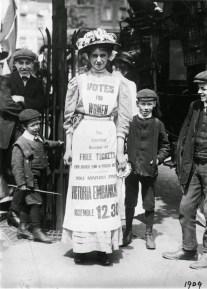
I went to see the film ‘Suffragette’ at the weekend. It was definitely worth seeing, but a bit grim. And why did they have to film so much of it with a hand-held camera? Some of the scenes were so jerky I could hardly see what was happening, or bear to look at the screen, because it was making me feel ill.
Still, a good film, all the same. It’s frightening to think how bad things could have been for women (and for working people) less than a hundred years ago. It’s an inspiring story, but at the same time, it made me wonder just what the point was; why so many brave women put themselves in the way of harm and suffered so much in order to try and get the vote (which took another ten years from the time at which the film was set). There’s a scene in the film where the main character’s husband, a very conventional, unsympathetic, uncommunicative, monarchy loving man, asks her what she’ll do with it, if she gets it (meaning; what will she do with the vote). And she says’ ‘same as you’. Which I took to mean that she was going to give it away to a representative of the privileged few, so that they could continue to oppress her and people like her. And I wondered what’s really changed. Because that’s exactly what still happens – the unthinking masses, fooled by lies and misrepresentations in the media, give their votes to representatives of the privileged few, who use it to continue to oppress them. So the suffragettes achieved equality in voting rights, but it seems to me to be an equality of ignorance. And until we have an honest, fair, bi-partisan media, as well as honest, fair politicians, I can’t see that anything is really going to change.


 literarylad