
You know how it is when you start watching the first episode of a TV series, and find it so irritatingly bad you’ve no choice but to stick with it for the full hour? And then watch the rest of the series too? So it was for me with the the recent BBC2 ‘docu-drama’ ‘Mozart – The Rise of a Genius’. Fortunately there were only three episodes, so just the three hours of raging at the TV screen.
You might think three hours was enough time to give a comprehensive picture of the life and career of our Wolfgang (or ‘Wolfie’, as I like to refer to him). But a large portion of the airtime was wasted on talking heads giving their thoughts on what Mozart might have been feeling about events in his life, or what his motivation might have been for doing something. Some, like the star soprano Lucy Crowe, had a long and intense musical training and career to draw from. One was a historian. But the rest were ‘celebrities’ – actors, writers; even a comedian. To quote David Mitchell, they may not have known much, but they reckoned plenty. ‘They’, unsurprisingly, included the ubiquitious Stephen Fry, a well known atheist in danger of disproving his world view by reason of his own omnipresence – could it be that Fry himself is in fact god?
The term ‘dumbing down’ doesn’t suffice to describe the series. Particularly excruciating were the prolonged close ups on the talking heads while they gave it their best shot at producing a beatific smile (either that, or they needed winding) in response to an especially favoured piece by our hero (I’m guessing the music wasn’t even playing while they were being filmed).
The historical representations were at best highly subjective, and at worst, rather suspect. The story went that young Wolfie acquired his ability on the keyboard, and as a composer, as if by osmosis, without much help from anyone else. As a child he was oppressed by a controlling father. Leopold (or ‘Leo’, as I like to call him) was, apparently, a second-rate musician and composer who nevertheless recognised his young son’s talent, and set out to exploit it shamelessly, parading his child prodigy around Europe in order to make as much money from him as he could. When Wolfie’s first symphony was performed publicly, cynics suggested it had been written by his father, but how could that be – we know the boy was a genius?
When Mozart grew to be a young man and finally broke free from the greedy, coercive control of his father, he went out into the world as the archetypal outsider, without connections, desperately trying to break into the closed world of the musical establishment.
And so it continued. It was implied that he never received any help from anyone in developing his abilities – he did it all himself. There was no indication that the music he wrote might have been influenced by others; it was all totally original. The name Haydn was mentioned in passing, as someone who got to go to an event that Wolfie didn’t get an invite to. The programme omitted to mention that the two composers had a long association, with ideas bouncing back and forth and Mozart in particular benefitting from the advice and musical direction from the older, long established composer. No mention of the time Wolfie spent, as a boy, in the London workshop of J C Bach, or the obvious influence of Bach’s work in Wolfie’s music (including his famous requiem).
Very little of Leo’s music remains, but what there is shows him to have been a very competent composer, and for me, Leo’s musical mannerisms are clear in his son’s music. He was also, I suspect, a great teacher. The relationship was undoubtedly difficult, but neither father nor son perhaps behaved as well as they might, and Leo too may have had reason to feel aggrieved, not least over the death of his wife while in his son’s care.
Away from his father’s influence, it was shown how Wolfie initially found success, but quickly blew it due to irresponsible behaviour; living beyond his means, excessive drinking and partying (I’m not sure the leather jacket and steampunk sunglasses were actually true to the period!) Perhaps, after all, Leo had good intentions in trying to guide his son’s career. And as for the suggestion that he was jealous of Wolfie’s success? After sacrificing his own career ambitions and devoting most of his energies to developing the son he recognised as a superior talent? Is that really likely?
The programme’s claim that Mozart was an outsider all his life really doesn’t compute. He may have been struggling to climb the greasy pole, but he was doing so from within the establishment – young Mozart had influential support and connections. It wasn’t until towards the end of the final episode that they casually mentioned he was a freemason. Was? In fact this renegade composer had been welcome at all the best lodges for the past six or seven years. They probably would have kept quiet, had it not been required information in the explanation of Wolfie’s last opera ‘The Magic Flute’, the plot of which they described, in a piece of unrivalled selectivity, as ‘an opera about an evil woman who tries to make her daughter kill her father’.
I nearly fell off my chair!
The libretto of TMF has a convoluted and somewhat dappy plot in which the patriarch who kidnaps his daughter and imprisons her in the care of a jailor intent on rape is somehow portrayed, through the magic of masonic mumbo jumbo, as the hero, while the distraught mother (the Queen of the Night – that ‘evil woman’) gets to play the bad guy. All it really tells us is that eighteenth century morality was rather different to our own. I think they used to refer to it as ‘The Enlightenment’.
I guess you could at least say that we got to hear some great music (albeit in fragments). Wolfgang undoubtedly had an astonishing talent, and an understanding for, and way with the structure of music that was extremely rare. And, unusually, he managed to make the incredibly difficult metamorphosis from child prodigy to brilliant composer. But like most, possibly all composers, he took influence from others, developed what had gone before, and interpreted it in his own way. This is evident in his music. He frequently ‘borrowed’ from other composers, including Clementi (who apparently wasn’t impressed!) Handel and Gluck. In his defence, the practice wasn’t at all unusual for the period.
I think it’s great to celebrate Mozart’s special genius. But for the sake of reality, his place both in society, and in the classical genre should have been properly established too. Mozart was integral to the classical period. He was special, but so were others. Personally, I believe Franz Joseph Haydn’s music was, on the whole, greater (but that’s only an opinion – please don’t shout at me!)
I’m just saying – other geniuses were available…
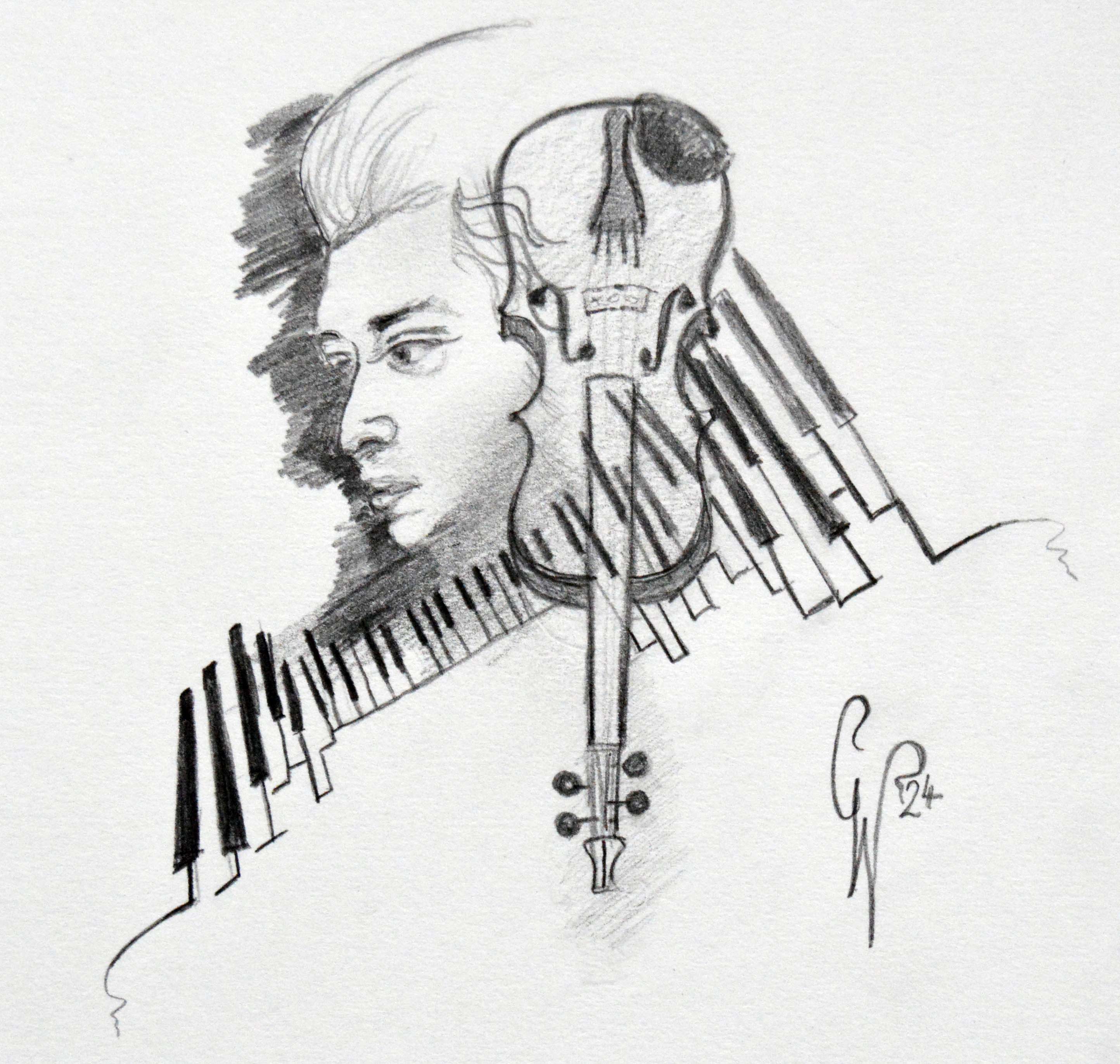
text & sketch © graham wright 2024


 literarylad
Great piece! Speaking personally, I’ve always favoured Bach over Mozart, so your views had resonance for me.
A great post! I’ve never researched much on the famous musical geniuses and their histories, so this was a venture into a whole new world for me. It’s a pity to hear that you didn’t enjoy the series but I’m glad it prompted you to share more about Mozart and the less obvious facets of his life.
Thanks Damayanti. TV aside, Mozart’s music is there for me (for all of us) to enjoy.
Brilliant post, you really opened my eyes to certain facts about Mozart. It is always ‘interesting’ when clowns and their cheap comments take on a genius. G 🎹
Postscript: I appreciate your artwork. G.