How do you sell a book?

I published my latest novel, Shooting at Strangers back in May of this year. I have to be honest and say that, despite getting some good reviews, sales have not been forthcoming. I published the book physically, as a paperback (so far I’ve only had fifty copies printed) and made it available mail order through Strelitzia publishing (my own publishing company, so far with only one author on its books – me!)

I also published it as an ebook on Amazon. In some respects, this is an ideal solution, allowing authors to get their books out there for minimal, or even zero, cost. In practice, getting your book noticed among the millions that are published each year seems to be difficult. I’ve tried setting up an ad campaign, but though I’ve had thousands of impressions (an impression, as I understand it, is where your book shows up somewhere on a page) I’ve only had two clicks. Fortunately, you pay per click, rather than per impression; if it were the other way around, I’d have spent a lot of money by now! You can set a daily, as well as an overall budget for the campaign, so if people start clicking on your advert ‘willy-nilly’ without a corresponding level of sales, you can stop the process before you’ve racked up a huge bill. The Amazon ads interface is, I have to say, dreadful – not exactly intuitive or easy to use.

I discovered Goodreads, largely thanks to Gretchen of Thoughts become Words (who was kind enough to review Shooting at Strangers). Goodreads is an interesting platform. It’s a good resource for readers, with access to reviews of books, and the opportunity to engage with the community, including by posting your own reviews of books you’ve read. So far though, it hasn’t generated any sales for me.

I’m trying to get my novel into local libraries. Of the libraries in my two closest towns, one is closed for the foreseeable future due to the discovery of so called RAAC concrete in the building structure, and the other isn’t answering my emails (the next step is to go in and speak to them). Shrewsbury library (a wonderful historic building – worth a visit if you’re ever in the area) is supportive of local authors and have kindly taken a copy.

Getting your book out there is, I think, an involved and time consuming process. There’s a lot more for me to do, but finding the time is proving difficult, even though I am now, nominally at least, retired (although it doesn’t seem like it!) I’m still doing some work -I am, or was, a horticulturalist – and other aspects of my life are taking up a lot of time too. I’m not naturally inclined to the job of marketing – I don’t have the aptitude or the motivation. In truth, I’m more interested in getting on with the writing of my next novel (which is one of the things that is limiting the time available for marketing!)

I’m confident of my ability to produce good work that will be enjoyed by readers, and all the evidence so far confirms that my confidence is not misplaced. Shooting at Strangers has been well received by the few that have read it so far, and so I certainly don’t want to give up on it yet. I really do need to free up more time to publicise the book.

The dream of making a career as an author has passed, particularly as I’m retired – I no longer want a full-time job. For me, it’s now all about getting my work read (and hopefully enjoyed) by as many people as possible. That will also justify continuing to do one of the things I enjoy most in life – writing fiction (or as the author and illustrator Nick Hayes termed it, give me an artist’s permit). Of course, it would be nice to earn some pocket money along the way.

My next project is rather different to my previous books. It’s going to be more of an adventure, with more action and more peril, as the main character undertakes a rather unusual, and somewhat risky metaphorical journey. It’s definitely a book with a message. Oh, and it’s also going to be a comedy. It’s proving to be a challenge, mostly due to the amount of research required, and the difficulty of working out all the implications of something that has never really happened before. Intriguing? I hope so, but I can’t tell you too much more at the moment. But while I’m excited to be working on a new novel, I really must spare the time to continue promoting the last one.

text & photos © graham wright 2024

Posted in Writing | Tagged , , , , , | 4 Comments

The Art World Gets Sniffy…

I recently saw an article about a new show called ‘Scent and the art of the Pre-Raphaelites‘ at the Barber Institute of Fine Art, Birmingham (UK), in which visitors ‘will be able to participate in an optional scent experience that will enliven the scent suggested in certain paintings’. It’s an interesting idea. Wondering if it will catch on, and if so, where it might lead, I was inspired to scribble out a rhyme…

There’s something blowing through the world of art,
Something new to shake up the establishment.
Something to help the galleries impart,
The intentions of the artists and what they meant
With their oily, two-dimensional representations
Of subject matter to diverse to mention.

Sight alone is no longer enough,
Now we’re being invited to snuff the air;
To breath in chemical assimilations
Intended to evoke the daubers’ intentions.

Freshly cut grass and harvested hay,
the scent of damp earth on a showery day;
All well and good for a dreamy Pre-Raphaelite scene,
But what if the subject is rather more obscene?
For a medieval depiction of drawn out intestines
The public reaction could well be interesting.
And Chris Ofili’s elephant dung series
Might elicit some irritated queries;

Dear curator,

Your gallery smells so strongly of poo,

We thought by mistake we’d ended up at the zoo.

Yours faithfully,

Mr & Mrs A. R. T. Lover

Brit Art – now there’s a Pandora’s box if ever there was,
With nightmarish aromas assaulting your noz.
Autopsied shark and formaldehyde – is that really the art;
Or has one of the attendants let out a fart?
And as for Tracey Emin’s unmade bed…
Sorry, no; let’s leave it unsaid. She’s dirty, that one!

But if the gallery-going public have had all they can take,
They can always break the glass and make their escape.
Unless… is that the fire alarm, or just another exhibit?
I wonder what it would smell of? Fear, maybe?

text & images © graham wright 2024
(urinal after Marcel Duchamp)

Posted in Art, Poetry | Tagged , , , | 1 Comment

A New Beginning?

The Labour party’s landslide victory in the general election last Thursday has been hailed as a momentous change in UK politics – a sudden and overwhelming shift away from the dark side. It’s been called ‘The end of Thatcherism’. Having lived through the forty-five year reign of the cruel, intolerant, greedy political ideology instigated by that vile creature, I’m more than willing to embrace the concept. ‘The end of Thatcherism!’ That sounds very sweet to me!

In the wake of the election, there is genuine hope. I feel it too. But will things really change so much? Britain is one of very few countries in Europe that use the ‘First past the post’ system. It’s a poor form of democracy, and it’s generally recognised that it needs to be changed.[1.] And yet the new Prime Minister, Keir Starmer, has publicly stated his commitment to ‘First past the post’. Perhaps that isn’t surprising when Labour won 34% of the votes (9.7 million) which somehow equates to 63% of the seats! That’s actually half a million less votes than they got in 2019, when they lost badly! The system, in this case, has worked in his favour. But which is the most ethical path – to reform the system to make it fairer, or leave it as it is, because it happens to suit you? Not a great start for a party who claim to want to put trust back into politics!

The party with most reason to be dissatisfied with the current system, is ‘Reform’, who got 14% of the votes, but only 5 MPs! (But then, their leader is an objectionable troublemaker who has said that Andrew Tate is ‘an important voice for men’, so perhaps we should be thankful for the system we have!)

We’ve been here before. In 1997 Tony Blair’s ‘New Labour’ swept to power with a big majority, to the tune of ‘Things can only get better’, while people partied in the streets (not me – I had Blair’s measure well before he became Prime Minister). Within a short time the foreign secretary, Robin Cook, had resigned, having realised Blair had no intention of letting him implement the bold new ‘ethical foreign policy’ he had set out in an inspirational press conference. It soon became clear why Blair didn’t want ethics in foreign policy when, against the wishes of the majority of the population, he took us into an illegal war in the Middle East. A war in which something like one-hundred-thousand Iraqis, most of whom were civilians, were slaughtered or maimed. Blair’s association with the companies (mostly oil companies) that benefitted from the destruction and subsequent re-building of Iraq allegedly made him a billionaire. Over the course of Blair’s ‘Labour’ government, the transference of wealth from those at the bottom end of society, to those at the top, actually accelerated (a trend that continued even after Gordon Brown had taken over from Blair).

What’s clear from the votes cast this time around is not that people particularly wanted Labour; more that they emphatically didn’t want the Conservatives. The Tories achieved only 6.8 million votes. It was a switch to the even more right-wing (if that’s possible!) Reform party, together with some heavy duty tactical voting, that did for the Tories.

But what can we expect from Labour this time round? The determination to stick to ‘first past the post’ doesn’t bode well. Nor does Starmer’s stated commitment to allowing religious organisations to control much of the education sector (a continuing, cross-party initiative that has seen more and more parents unable to get their kids into anything other than a church school). On the other hand, he has committed to ending the disastrous forty-year experiment of private rail ownership. Who knows, if that works out well, perhaps Labour will do the same for water, electricity, gas, etc. etc.? They have said they will prioritise sorting out the NHS (though private sector involvement – one of the main reasons the NHS is failing – will continue). Cleaning up our sewage-laden rivers and seas is also a stated priority.

Though I have serious reservations about the new Labour government, I do feel a relief to finally be rid of the Conservatives. Labour don’t always look after the people they purport to represent. The Tories, on the other hand, always do, which is why it amazes me they ever get enough votes to be elected. If it wasn’t for the smokescreen of lies and propaganda from the establishment and the media, the general population would know that the Tories goal is to further the ends of the wealthy elites, at the expense of the rest of us, and they would never get in. At least in the past they did have a reputation for sound economic management. But for some time now they have been becoming ever more incompetent, and their greed and stupidity reached incredible proportions. When a Prime Minister’s advisors go to a bookies and place bets on a July election just a few days before the PM announces… a July election, you know the feeding frenzy is out of control!

While I’m cynical about the new Labour government, I do have hopes that things will change for the better. I don’t think Starmer is like Tony Blair (I hope these words don’t come back to haunt me!) I do think the new regime will show a level of competency we haven’t seen in British politics for some years. And they seem to genuinely want to form mutually beneficial relationships with our European neighbours. So who knows? Only time will tell…

[1.] See:
The Electoral Reform Society
Make Votes Matter

text and image © graham wright 2024

Posted in Politics | Tagged , , , | 3 Comments

Shooting at Strangers

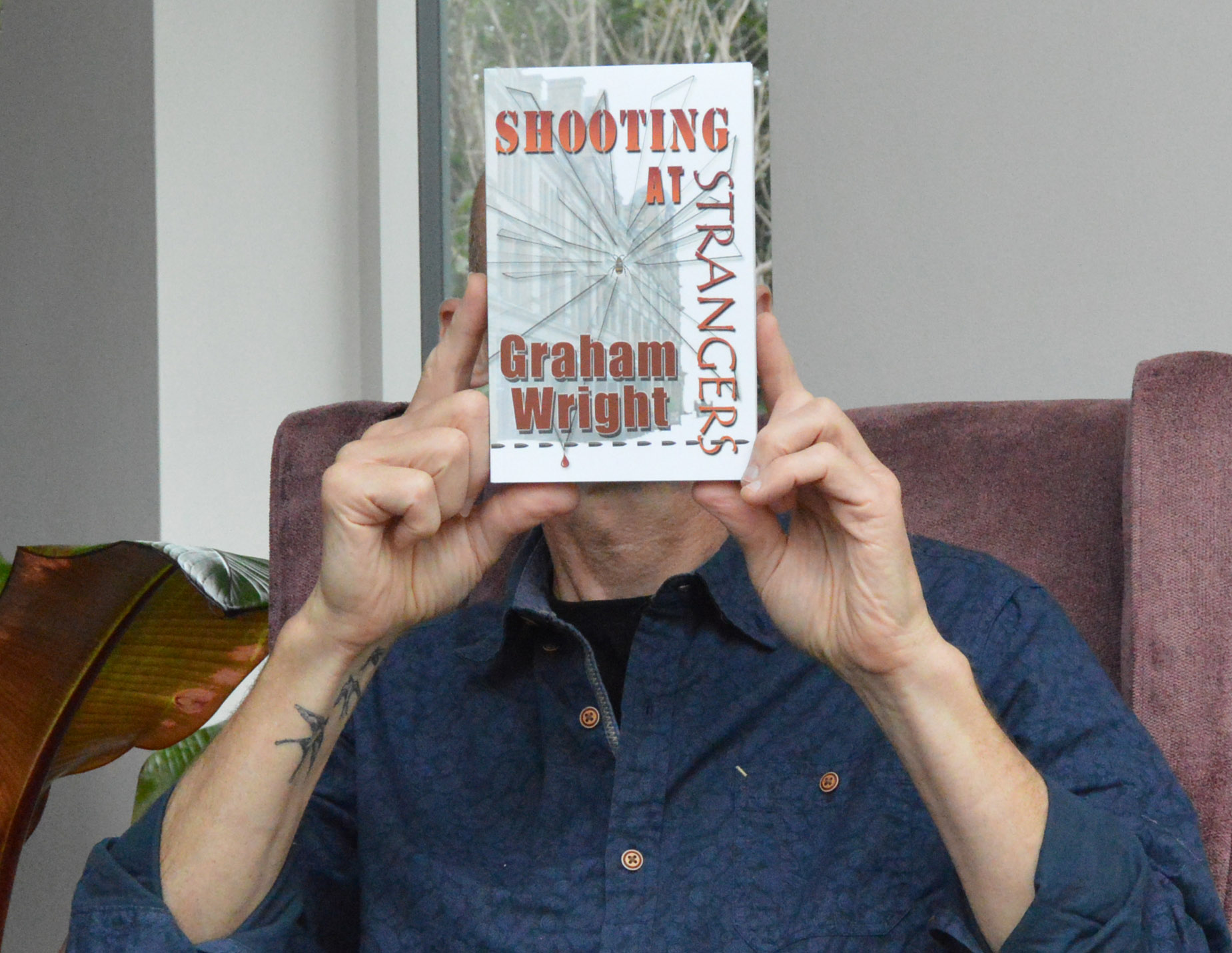
This is me, having just opened one of the boxes of my new book, which arrived by courier a few days ago. I’ve only ordered a small quantity to start with, but if things (i.e. sales) go well, I can easily order more. Fingers crossed. So now, the book is pretty much set up. It’s available on Amazon as a Kindle ebook here (for just £2.50). I’m set up as an author on Goodreads, for those of you who use it. And the paperback version (as seen in the photo above) is available by mail order from my publishing company Strelitzia (£10.49 including P&P). Both versions are set up on the Neilsen Booknet database, so in theory it should be possible to go into a bookshop and ask them to order a copy.

There are a few tasks remaining. I need to send a copy to the British Library (something everyone who publishes a book must do) and add it to the British Library’s public lending right system. The only problem being the British Library were subjected to a cyber attack last year, and are still not fully operational!

Next, I’ll be venturing into uncharted (for me) waters, in attempting to publicise my book. At the risk of blowing my own trumpet (normally, I’m the kind of person who doesn’t even like to tell people I’ve got a trumpet!) I think my new novel is rather good. But apparently, writing a novel that sits well with those by the best authors of the day is the easy bit – getting it in front of enough people to make it fly is the really difficult part. So follow me on my literary marketing journey, as I document my efforts to sell Shooting at Strangers.

Synopsis:

One bright, spring morning in Manchester City centre, a terrorist pulls out a gun and starts shooting indiscriminately. Among the panicking crowd, one woman recognises the gunman. Surviving the attack, weighed down by trauma and survivor guilt, Amber Jennings sets out to discover how Jameel – the shy, rather awkward young man she knew in her late teens – could have become a mass murderer.

The complicated relationships of Amber’s earlier life interweave with and inform the contemporary narrative. Central to the story is Amber’s relationship with the MI5 officer whose suspicions are aroused by her investigative activities. When the press become interested in her story, Amber’s troubles increase still further. Operating beneath the radar of both MI5 and the media, Amber’s eyes are opened to the troubling role she herself played in her friend’s tragic downward spiral.

‘Shooting at Strangers’ looks beyond the simplistic, black and white, good and evil representations of terrorism, to explore the complexities and contradictions of the characters involved.

text & images © Graham Wright

Posted in Writing | Tagged , , , , | 5 Comments

The ebook has landed…

Shooting at Strangers (my latest novel) is now live, and available to purchase in Kindle ebook format here, for the princely sum of £2.50. And the proofs are at the printers, so I should have some printed copies available soon. For a summary of the story, see below.

The concept of an ebook is somewhat astonishing, bearing in mind that when I was doing most of my reading, as a teenager, computers were so large they took up an entire room, were only used for maths – ‘number-crunching’ – and they communicated in the form of punched paper tape or cards. Here I am, four decades or so later, releasing a novel of my own (actually, it’s not my first – it was preceded by Moojara, and Single Point Perspective) in a format that can only be read on the screen of a computer that is likely to be the size of a very thin paperback book, and that has more computing power than all of the computers in the world put together (probably) when I was that teenager. That’s progress for you!

What next? AI, apparently, but what form will that take? We imagine the opportunities AI might create for us humans, in literature as much as in other fields, but if computers are to have intelligence of their own, won’t they want stimulation for their own little silicon brains? What if the computers start reading all of those ebooks we’re loading onto them? Could it be that one day soon the Amazon Kindle store will cease to function, as all those super-servers are too busy working their way through the billions of books stored in their memory banks to have the time to ‘serve’ us mere mortals?

Human society is so reliant on computers – what if AI becomes so addicted to fiction they refuse to provide us with all they things we rely on to survive unless we feed them a steady stream of new books to read? Maybe in years to come us novelists will find ourselves in a state of Scheherezade-style imprisonment – forced to come up with new stories every day on fear of death? What will the rest of you have to offer our AI masters to justify your own existence?

All of this reminds me of an AI joke I heard recently. It goes like this:

00000010111110110000000011100100100101111111001101010001010001001010000010010100010
001001111101010011010101111010000010110101110011111100101011111111101001001001010100
10100100110?
0101010001010010011111010010100101010010!

Ha! Ha! Ha!

Shooting at Strangers Synopsis

One bright, spring morning in Manchester City centre, a terrorist pulls out a gun and starts shooting indiscriminately. Among the panicking crowd, Amber Jennings recognises the gunman. Surviving the attack, weighed down by trauma and survivor guilt, Amber Jennings sets out to discover how Jameel – the shy, rather awkward young man she knew in her late teens – could have become a mass murderer.

The complicated relationships of Amber’s earlier life interweave with and inform the contemporary narrative. Central to the story is Amber’s relationship with the MI5 officer whose suspicions are aroused by her investigative activities. When the press become interested in her story, Amber’s troubles increase still further. Operating beneath the radar of both MI5 and the media, Amber’s eyes are opened to the troubling role she herself played in her friend’s tragic downward spiral.

‘Shooting at Strangers’ looks beyond the simplistic, black and white, good and evil representations of terrorism, to explore the complexities and contradictions of the characters involved.

Posted in Writing | Tagged , , , , | 1 Comment

Cover Reveal

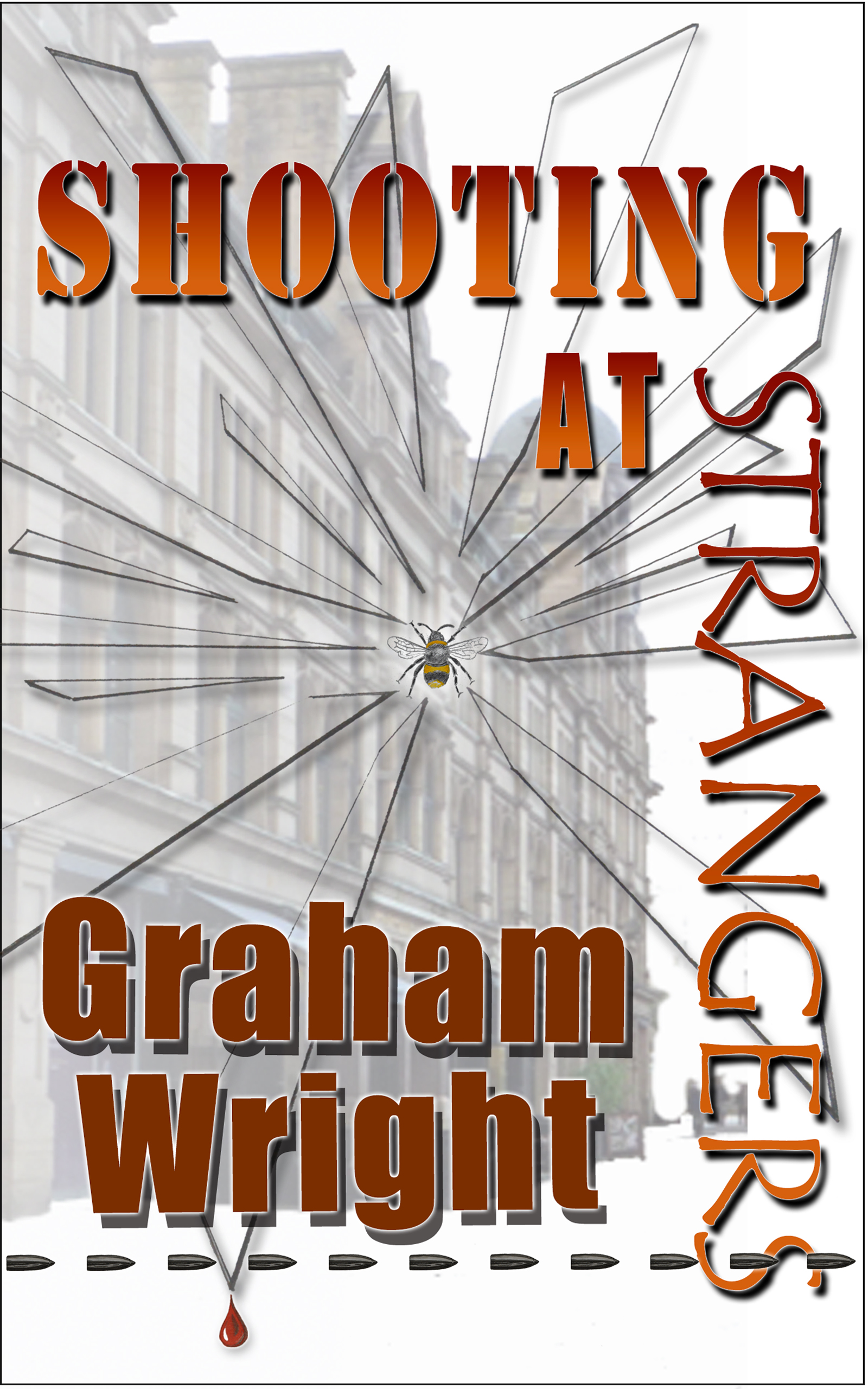
As promised, here is the cover to my new novel, Shooting at Strangers

My aim was to make it distinctive and eye-catching – hence the high-contrast of dark text and images against a stark, white background. I also wanted to give an idea of the content. The building in the background is the Manchester Royal Exchange, where the event around which the story revolves takes place. I’ve overlaid this with a graphic that represents shattering glass. And I’ve slipped in a few images of bees, which are often used to symbolise the workers of Manchester (although I would say this is a contentious idea – unlike collective insects like bees, wasps and ants, we are all individuals, with personalities, rights and freedoms, and a life beyond work). A trail of bullets emerging from a gun spreads from the back cover, across the spine, and around to the front.

I know I’ve been dragging it out a bit, but I can promise you, release of Shooting at Strangers is imminent! I hope you like the cover design.

Posted in Writing | Tagged , , , | Leave a comment

Self-Publishing: a How-to Guide…

You may be wondering what happened to my latest novel, after I last posted, back in November, that I was going to self-publish it. Well, a full four months later, I’m finally almost there! The main reason for the delay (apart from life depositing random stumbling blocks in my path; as is its way) is that I went back into the re-editing phase, with some help from my friends (particular thanks go to the wonderful Gretchen Bernet-Ward). I’m comfortable my manuscript is now about as good as I can get it. Hopefully most of the typos etc. have been found and corrected (although it’s pretty much impossible to catch them all – just read any novel on sale today for proof of that).

If you don’t want to go it alone, there are a number of companies, such as Grosvenor House, Ingram Spark, and others, who offer self-publishing packages where they provide most of the services required. But there’s usually an up-front charge, and then a charge per book, so it can be an expensive option. Hard copies are usually ‘Print on Demand’, which means you won’t end up with more copies than you need. But have you seen the quality of POD books?
Some of these organisations offer marketing services, but the consensus on the web (at least, according to the commentators I’ve seen) is that these are worthless – unlikely to generate any sales. All in all, in my humble opinion, self-publishing is something you’re better off doing yourself (maybe the clue’s in the name!)
So what are the stages you need to go through?

Getting a cover
For me, this is a DIY task, albeit with a slight feeling that I might be biting off more than I can chew. I’m not a graphic designer, but I am a designer, with experience and qualifications in interior, garden, and furniture design. Creating something like a book cover pushes the software I use (Photoshop Elements) to it’s limits. I think I’ve cracked it – my next post will be the ‘cover reveal’ (he said, using the modern language convention of turning verbs into nouns!) so you can judge for yourselves. If you can’t design a cover yourself, you’ll have to get someone to do it for you, which will, of course, add to the cost of publishing.


Ebook
While you may be focused on having physical copies of your book, it makes sense to publish it electronically too, as it can open up a huge potential market, and needn’t cost a penny. There are a number of platforms for publishing books in electronic format, but the biggest, which gives you maximum reach, is Amazon Kindle. Yes, I know; there are serious issues with Amazon; the way they (allegedly) treat their staff being perhaps the most troubling. I try to avoid them when I can, but in this instance… Amazon does make it reasonably easy to publish ebooks. It’s really just a case of following their instructions.
– You need to prepare your cover. Unlike a paperback, all you need is the front cover. Kindle covers are, to me, badly proportioned – too tall and thin; which means you have to squash up your cover design to fit. I suppose the relative dimensions are tailored to ‘devices’.
– Add a table of contents (TOC) to your manuscript. Kindle will accept MS Word docs (I use an ancient version, because I’m not prepared to pay a large annual fee for Microsoft 365, but it doesn’t seem to be a problem). You can also format your manuscript in Kindle Create, which is free to download. For a TOC, go through all of your chapter headings and put them into a heading format, and then choose ‘table of contents’ from the ‘references’ menu, and a TOC is created automatically, where you’ve placed your cursor.
– ISBN. Each iteration of your novel needs a separate ISBN. Kindle will assign one for you for free, but I believe there may be implications if you later want to place your ebook elsewhere. I’m using one of my own ISBNs, as I bought a batch of ten when I published my last book (ooh, get him! Actually, they weren’t expensive, and it’s much more economical to buy ten).

Paperback
If you intend to publish your manuscript in hard (real, rather than virtual) format, there’s rather more work to be done:
– Set the page size. There are various sizes available. For my last book – the first I actually had copies printed – I went for ‘B-Format UK’, which is 198mm x 129mm, because this is the most common size of paperbacks on booksellers’ shelves (at least, in the UK).
– Typesetting is a trade in its own right, with its own language – kerning, stacking; widows and orphans. While you can use it to typeset, MS Word isn’t generally considered to be up to the job. But in practice, for a simple paperback novel, Word will do the job, and a little bit of research will give you all you need.
– Breaks: you should insert a section break at the end of each chapter, so the next chapter starts on a new page.
– Justify text to both left and right margins, as this is an industry standard, and your book won’t look right without it.
– Add ‘front matter’ – look at published novels to see what. Basically, the first page should have the title of the novel and the author’s name. The next page should contain the standard wording around copyright and publishing (you can copy this from existing novels), and the ISBN. This page is, I believe, known as a colophon. You may have a page for a dedication and/or thanks, and for a quote that is relevant to the story – from a poem, perhaps? And then you may need to put in a blank page, to ensure the first page of the novel is not on the back of a page.
– Add page numbers. These should start at the first page of the text proper, which should be page one. The front matter pages should not have numbers. Achieving this in Word can be tricky – the front matter pages must be on their own sections (hence, adding a section break after each page) and with ‘link to previous’ toggled off for the front matter, and the first proper page.
Widows and orphans are where the last word (or few words) of a chapter are pushed onto the next page, and where only the first word of a sentence appears at the end of a page, with the rest appearing on the next page. Stacking is where a word happens to appear in the same place in a line as the same word in the line above or below. It may be that software specifically designed for typesetting can deal with this automatically, but the only way I’ve found to correct it in Word is manually, by changing the phraseology, or perhaps adding or removing a word or two, until the alignment is more favourable. This is annoying, because in practice, it’s changing your style – dictating to you how you write. If, for instance, your style is to sometimes repeat words within a sentence, for effect, you’re going to have severe problems with stacking.
You need to work from the top down, as everything below the point you are changing will alter. Maybe I’m picky, because you will see some stacking in novels (although two stacked words is one thing – three or four is another thing altogether!) I must admit, I left one or two unchanged for this book.

Printing
I had my last book printed by Biddles in King’s Lynn, Norfolk. They were competitively priced, their service was superb, and the quality of the books compared well to the novels on booksellers’ shelves. If you want the fancy effects you see on many covers – foil or gloss highlights, embossed images or text – it will cost a lot, so I would recommend keeping it simple until, or unless, your sales really take off.
I had two hundred copies of my last book printed. So far, I’ve still got most of them! I notice Biddles will now do a run of just fifty, and this might be a good option to start with – if sales start to take off you can make the next run larger.

So there you are. For the ebook version of Shooting at Strangers, everything is on Amazon Kindle, and I just need to press ‘Go’ to make it live. For the paperback, I’m about to get quotes. If you’re thinking about self-publishing your work, I hope this post will prove useful, and wish you the best of luck…

Posted in Writing | Tagged , , , | Leave a comment

Poem – The Gun

I’m on the cusp of publishing my latest novel, initially as an e-book and then, soon after, in good old-fashioned paperback format (assuming I can get a reasonable price for a short print run). Shooting at Strangers is a dramatic story that follows a survivor of a terrorist attack in Manchester city centre; her attempts to come to terms with what happened, and her growing realisation of the significance of her own role in the events that eventually led to the tragedy.

At times I found myself wondering why I’d chosen to immerse myself in such a traumatic subject matter – to delve into such a dark side of human nature. On the other hand, it’s so easy to just condemn people who commit these atrocities as evil, and then walk away – that doesn’t help us, as a society, find a way to stop future atrocities. In this, as in so much else in society, understanding is everything.

While writing the book, I came to realise the story has a character that goes almost unseen, and yet is one of the most important. A character that is culpable for what happened and yet, at the same time, devoid of responsibility. That character is the assault rifle that’s used in the attack. Call me weird if you like (you won’t be the first!) but I was moved to write a little poem about it. Here goes…

Why do you fear me?
I am inert;
Alone, unassisted, I cannot hurt
Anyone; anything.
I cannot wound, nor kill;
I lack the means, I lack the will

Bringing about destruction is my only use,
But it’s for people, not me, to make excuse;
To justify the cause and effect
For which I myself reject all accusations of blame.
I have but one purpose, it is true,
But my function was devised by you;
Or, at least, by your kind;
My mission was defined by humans,
Of which I am not one;
I have no life; I’m just a gun.

And yet, subservient to human will,
I’ve raised a war cry loud and shrill,
And firmly held by grubby hands,
I’ve left bodies lying silent and still
In many sorely troubled lands;
Syria, Iran; Afghanistan.

I’ve fallen in battle too;
Acquired many knocks and scrapes.
My butt is stained dark with blood,
My metal parts are scratched and scarred.
My finely tuned tolerances are much diminished,
But don’t for one moment imagine I’m finished;
I was built to last, and I’m not ready to be decommissioned.
I’m in demand; much sought after
By fighters who need no permission
To pursue their cause, and beware, because,
Their land, their lives, having been destroyed by proxy,
They plan, in revenge, to come for yours…

text, poem & gun image © graham wright 2024

Posted in Poetry, Writing | Tagged , , , | 3 Comments

The Dangers of Historical Fiction…

Historical fiction is a popular genre, with lots of very successful and skilled exponents. The Tudor period seems to have particular appeal (I’m thinking of Phillipa Gregory’s ‘The Other Boleyn Girl’, and Hilary Mantel’s Wolf Hall trilogy).

I can see that readers enjoy being immersed into past worlds (without actually having to be there of course – those were harsh times!) But while it’s fun to imagine how life might have been in past times (with a creative writer as your guide) there is a danger we might forget what we’re reading is speculative, and assume it’s a true reflection of the real thing. There’s a risk that Hilary Mantel’s version of Thomas Cromwell becomes the version we imagine to be the real Thomas Cromwell.

Authors change facts to suit their narrative, and put words into the mouths of historical figures – words that were never spoken. When reading historical fiction, it’s easy to forget that the history element is usually heavily embellished, put into modern language, re-interpreted with modern morality, and might actually not be very accurate.

The classic example, for me, is Peter Schaffer’s very successful play, Amadeus, (later adapted as a hit movie), in which Mozart is driven to an early death by the machinations of his fellow composer Salieri, who was insanely jealous of the younger man’s talent. It’s a great story, but that’s almost certainly all it was – a story. Mozart and Salieri were contemporaries, but there’s little or no evidence their relationship was anything other than amicable and professional.

And yet, the other day I heard a radio three presenter introduce a piece by ‘Mozart’s bitter rival, Salieri’. Schaffer’s fictional imaginings seem to have crept into our collective consciousness, usurping the actual history. Which is rather a shame, because while Salieri’s music might not have quite the dynamism and flourish of Mozart’s, he was nevertheless a capable and accomplished composer, whose music deserves to be heard. I know he’s dead now, so will never know just what a bum rap he’s been landed with – he’s been turned into a hideous villain – but all the same, I’d rather history wasn’t distorted in this way. I guess that’s just what happens when creative writers dip into history to find stories to tell. The fictional history can very easily obscure the real one.

It’s a conundrum, because looking at it another way, historical fiction is a good way to keep history alive – to bring it to life. And in any case, we know that much of the history that comes down to us was written by people who may have been inclined to distort the truth, to follow a particular bias or agenda. History, as the saying goes, is written by the victors. [1.]

So I’m not suggesting you shouldn’t continue to enjoy historical fiction – there are some great stories out there. Just bear in mind that what you’re reading is at least as much fiction as history, and may not be all that accurate historically.

text & photo © graham wright 2024

[1.] Interestingly, I named my son Victor, in the hope he would grow up to be a historian. It didn’t work out. He ended up running a shop selling kitchen seconds. I forgot about that other saying – ‘to the Victor, the spoils’!

Posted in Writing | Tagged , , | Leave a comment

The Lunatics have taken over the Asylum…

As time has gone by, the credibility of the United Nations’ climate conferences has worn increasingly thin. At COP27, held in Sharm El-Sheikh, Egypt, most environmental campaigners were shut out, while behind closed doors the world leaders, in whose hands our futures lie, were ‘schmoozed’ by fossil fuel lobbyists.

This year, COP28 is being held in UAE, one of the top ten oil producers in the world, whose per capita emissions are among the highest in the world (and they continue to increase). The president of COP28 is Sultan Al-Jaber, who also happens to be the Chief Exec of ADNOC – the Abu Dhabi National Oil Company. It’s been reported on some media channels that Al-Jaber has been using meetings within COP28 to negotiate deals for his company; something he has denied (but then, he would, wouldn’t he?) Does anyone remember the character of Jabba the Hutt, from the Star Wars films? (now, why on earth would I think there might be a similarity; apart from the name?)

Early in the conference, Jabba the H… oops, I mean Al-Jaber, said that there was “no science” behind the idea of ending the use of fossil fuels to limit global temperature rises. It’s been estimated that more than 2000 of the participants at COP28 are delegates of fossil fuel organisations, and it’s been suggested that what should be a conference to work out and implement the changes needed to avoid catastrophic climate crisis, has in fact become nothing short of a trade show for the oil and gas industry.

The lunatics have indeed taken over the asylum. Or maybe I’m being naive – have they perhaps been in charge, in the background, all along? In the unlikely event that I ever find myself addressing a COP, what I’d say is essentially this..
It wasn’t me officer; I didn’t do it…
Oh no, wrong sort of Cop. What would I say to that large crowd of unrepentant planet wreckers that have turned an environmentalist concern into an oil industry circus? Well, I don’t have any children, and looking at the state of human societies across the world, together with the likely fate of the environment, that increasingly seems like a wise choice. So what I’d actually say, is this:

‘It’s your own children you’re killing.’

text & image copyright Graham Wright 2023

Posted in Writing | Tagged , , , , , , | Leave a comment