As time has gone by, the credibility of the United Nations’ climate conferences has worn increasingly thin. At COP27, held in Sharm El-Sheikh, Egypt, most environmental campaigners were shut out, while behind closed doors the world leaders, in whose hands our futures lie, were ‘schmoozed’ by fossil fuel lobbyists.
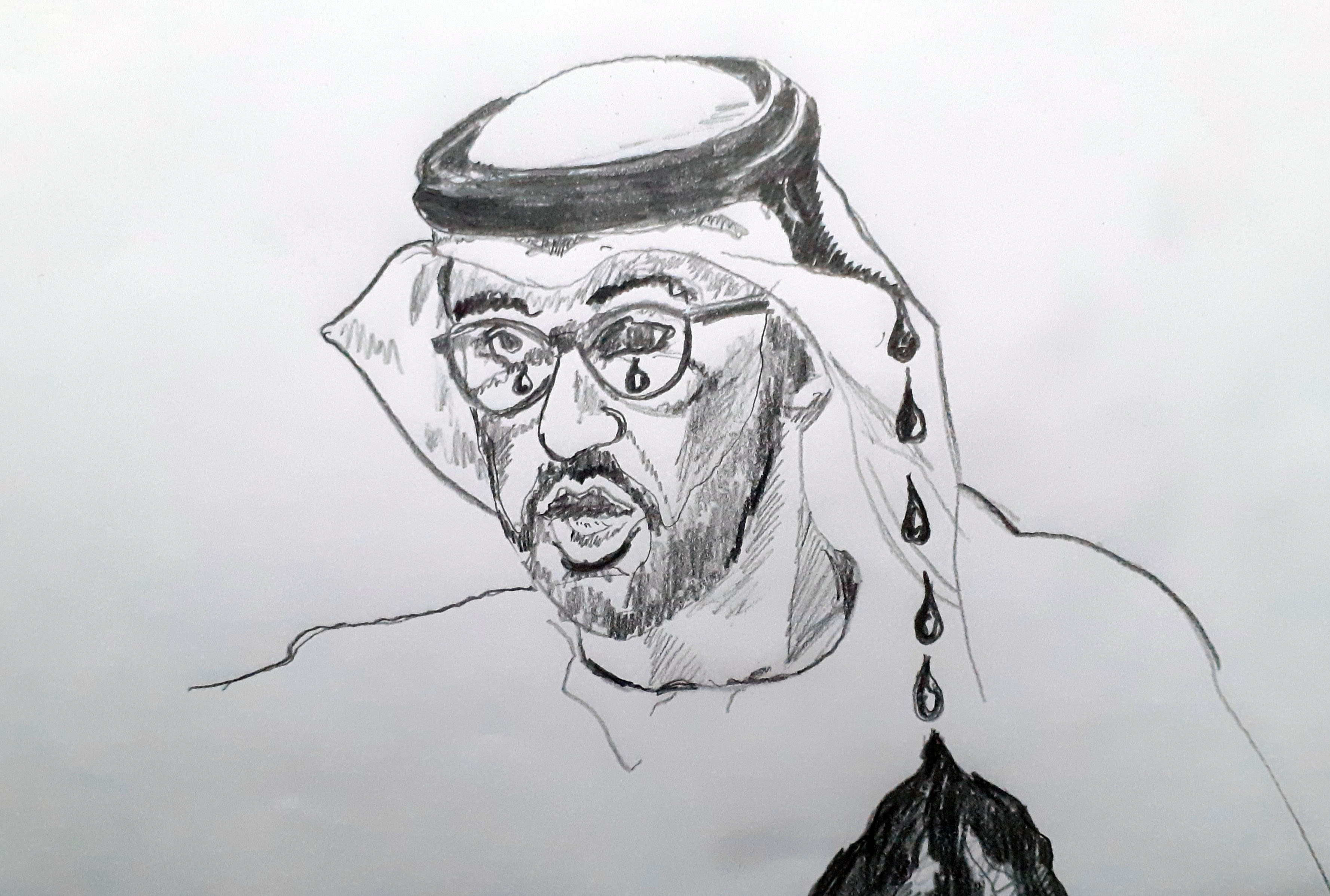
This year, COP28 is being held in UAE, one of the top ten oil producers in the world, whose per capita emissions are among the highest in the world (and they continue to increase). The president of COP28 is Sultan Al-Jaber, who also happens to be the Chief Exec of ADNOC – the Abu Dhabi National Oil Company. It’s been reported on some media channels that Al-Jaber has been using meetings within COP28 to negotiate deals for his company; something he has denied (but then, he would, wouldn’t he?) Does anyone remember the character of Jabba the Hutt, from the Star Wars films? (now, why on earth would I think there might be a similarity; apart from the name?)
Early in the conference, Jabba the H… oops, I mean Al-Jaber, said that there was “no science” behind the idea of ending the use of fossil fuels to limit global temperature rises. It’s been estimated that more than 2000 of the participants at COP28 are delegates of fossil fuel organisations, and it’s been suggested that what should be a conference to work out and implement the changes needed to avoid catastrophic climate crisis, has in fact become nothing short of a trade show for the oil and gas industry.
The lunatics have indeed taken over the asylum. Or maybe I’m being naive – have they perhaps been in charge, in the background, all along? In the unlikely event that I ever find myself addressing a COP, what I’d say is essentially this.. It wasn’t me officer; I didn’t do it…‘ Oh no, wrong sort of Cop. What would I say to that large crowd of unrepentant planet wreckers that have turned an environmentalist concern into an oil industry circus? Well, I don’t have any children, and looking at the state of human societies across the world, together with the likely fate of the environment, that increasingly seems like a wise choice. So what I’d actually say, is this:
Over the past ten months I’ve been submitting my latest novel to literary agencies – learning and honing my synopsis, and my approach, as I go… But it looks like I’ve been wasting my time – once again, I’ve drawn a blank, and it’s been a truly soul-destroying experience.
The role of a literary agency is, obviously, to represent writers, and promote their books to publishing companies. I know they like to complain about the volume of submissions they receive. But in what other profession does the product you need to sell arrive fully-formed through your letterbox (or rather, into your in tray) without you yourself having to do a thing? Okay, so they get too much product, and much of it isn’t up to standard, but all they have to do is to choose which ones they want to accept, and send the others back. Surely they’re blessed? You wouldn’t think so from the way they treat the authors who send them a potential product to sell, for free. Do they have any idea of how much time and skill goes into writing a good novel? However many submissions they get, can they really not find the time to thank those authors they choose not to represent. Isn’t that just common decency?
I submitted my manuscript to seventeen agencies. Each were very specific about what and how I should submit, which meant a lot of work producing a separate offering for each agency. I received five replies. Yes; that’s five out of seventeen who had the manners to say thanks (but no thanks).
And of those who did reply, none were prepared to give me any feedback. Although one did say my extract didn’t grab them to the extent they might have hoped. I’m inclined to think I’m up against the short-attention-span generation; people who need an instant hit, without having to think too hard. All of the agents do, on their websites, try to give an idea of what they are looking for. Which is generally formulaic storytelling to match what’s out there already. They seem more interested in their narrow idea of what they think they want, than in looking for something new, and keeping an open mind.
I know what you’re thinking; ‘or could it be, Graham, that your book, just isn’t good enough?’ It’s possible (because it isn’t possible for me to be truly objective). On the other hand, the few trusted readers I’ve given it to tell me it’s every bit good enough. And then there’s the quality (or rather, the lack of it) of what does get published (present company excepted, of course). My reading history is, among others; Marlowe, Austen, Huxley, E.M. Forster, Hardy (Thomas, not Oliver), Wyndham, Burgess, and A.S. Byatt. But when it comes to contemporary authors, with a few exceptions, I’ve always struggled – I really have. Too much repetition, unlikely plot twists, unlikely behaviour, characters that don’t ring true (or are positively two-dimensional), lack of consistency, continuity errors and clumsy phrasing.
There are more people writing novels than ever before; partly because computers make it so easy to get your novel down, and partly because, well… there are more people than ever before. You would think that among all those new books there would be quite a few that were top quality. All it needs is for the publishing industry to choose the best. Apparently they’re failing (because I can’t believe there aren’t still a lot of really good writers out there).
That’s what really hurts. If agents and publishers were putting out great novels by highly talented writers I could happily (well, perhaps not happily!) accept that perhaps my book isn’t quite good enough to compete. But based on the low standards of almost all the contemporary novels I’ve encountered, I’m left thinking ‘is mine really worse than these?’ I’m confident it’s them; the industry experts (is that ‘ex’ as in has been, and ‘spurt’ as in a drip under pressure?) rather than me. But then, I’m not a confident person. And then there’s that inescapable subjectivity…
What to do? Maybe I should try to get more opinions, from impartial readers… I’m inclined to think that in publishing, as in so many other areas of life, if you want a job doing right – do it yourself. In other words, I’m going to self-publish my book. More about that next time…
Or can this apparently destructive act sometimes be a force for good?
Image by Rafael Juarez from Pixabay
The furore over the quran burnings in Sweden have apparently sparked outrage in the Islamic world, and a difficult debate about freedom of expression in the more secular west. The Swedish government is torn between protecting the rights of their own citizens, and avoiding the damage to their reputation and interests, both abroad and at home, that will result from upsetting self-righteous Islamists.
As someone with a love of books – not just for their ability to educate and delight, but also for their sheer beauty – I find the idea of deliberately destroying books somewhat troubling. Book burning has sinister connotations, bringing to mind that gold standard of oppression, repression, ignorance, cruelty and genocide; the Nazi party. But books can also misinform, mislead; spread pernicious ideas that lead to oppression and cruelty.
To liken these current book burnings to the Fascism of Nazi Germany is either lazy thinking, or more likely, downright disingenuous. I would say it’s closer to the bra burning by feminists in the 1970’s. Making the decision not to wear a bra – an item of clothing they saw as representing the repression of women by a misogynistic, patriarchal society – was the real act of empowerment. The burning was merely symbolic; as well as an advertisement to women everywhere that they need not accept the status quo.
Bras, unlike books, don’t contain knowledge (although many people long to have knowledge of what they contain!) And whereas the Nazis attempted to burn all the copies of all the books they didn’t approve of, in order to withhold both information and ideas from society as a whole; as far as I’m aware, feminists only burnt their own bras, not other people’s.
When someone sets light to their own copy of a religious book, it isn’t an attempt to deprive others of access to other copies of that book, or the ideas it contains. Like the feminist bra burnings, it’s a symbolic rejection of a particular set of ideas (or indeed; a set of imposed behaviours) that you object to; a public statement of your disapproval. To take away one’s right to damage or destroy certain types of book is a dangerous attack on freedom of expression.
In an example of the growing and dangerous influence of the Islamic states, the UN Human Rights Council recently voted in favour of a resolution for “deliberately and publicly” burning the quran, or “any other holy book” to be prohibited by law. The resolution was introduced by Pakistan, and supported by the Organisation of Islamic Co-operation (OIC) – basically, all the Islamic countries. It was, of course, rejected by the more secular nations such as the UK, but they were outnumbered.
Bearing in mind that fire is the ‘go to’ element for Islamists who want to express disapproval for something, or someone, this seems to be an astonishing example of wanting to both ‘have your cake and eat it’. If you’re going to legislate against burning books, why not do the same for flags? If burning the quran is an insult to religion, then burning a flag is an insult to an entire country – an insult to millions of actual people, rather than to an ideology. And while we’re at it; why just protect religious books? Why not make burning any book a crime? Why shouldn’t the precious words of us hard-working authors be protected from harm too?
The book burning incident in Sweden was an act of protest by a refugee – an Iraqi Kurd, I believe – who burned a copy of the quran to highlight the cruelty and oppression he and others had suffered at the hands of a fundamentalist Islamic state. It’s likely that Russia is responsible for the widespread (mis?) reporting of the incident, with the express intention of persuading Muslim Turkey to continue to block Sweden’s accession to NATO. But of course, this policy is only successful because of the illiberal, dogmatic and oppressive nature of the Muslim world.
If only those who rage against such acts gave the same respect to their fellow humans as they do to the book that documents their ideology. In almost all Islamic states, choosing to leave the religion (i.e. Islam) you were assigned at birth is not permitted. In most, it’s a crime punishable by death. Which is more important: the right never to be offended by, for instance, someone damaging one copy of a book of which there are millions in existence around the world; or the right of an individual to develop their own world view?
And so I would conclude by warning that we shouldn’t let our respect for books eclipse that for our fellow human beings. Not all books are created equal. Some have good intentions; others promulgate hatred, misery and suffering. For those, we should have no qualms about striking a match…
NOTE: No books were harmed in the making of this blog post
It’s been a long time in the making, but finally I’m there: novel number three is at last finished. Thanks to everyone who read the draft. I’ve been encouraged that the feedback was so positive, and am grateful for all the suggestions that helped me to polish the manuscript and, hopefully, pick up the last of the typos and grammatical inconsistencies.
Fitting writing a novel around a busy life, particularly when you have another, full-time job, is difficult. Each time you feel you’re making significant progress, other aspects of life cut in to hold you up. This novel took around three and a half years from start to finish, but I didn’t want to rush it – getting it right is the most important thing. Now comes the task of finding an agent – not an easy thing to do when there are so many people writing.
Looking at agent’s websites, I’m struck by how prescriptive they are about what they’re looking for. In a way, it’s reassuring, because in many cases, I think the book I’ve written might just fit. All the same, it seems a little back-to-front. Do galleries dictate to artists what they should paint, and how, I wonder? The creative process is surely the preserve of the artist and writer, and agents should be keeping their minds open.
So what is the book about? Well, it’s a rather different take on an aspect of life that seems to be becoming ever more frequent. It deals with a terrorist attack in a crowded city centre. There’s action and intrigue, as well as a good measure of plotting, but my main focus is the on how the attack affects one of the survivors.
The central character, Amber Jennings, is a no-nonsense Salford girl, with a husband and two children. She’s survived the attack, but she can’t escape its consequences, and the aftermath promises to turn her life upside down. Amber was at the scene of the crime for a lunch date with an old flame. Both recognised the gunman as someone they knew at school. While Amber ran, her date challenged their old friend, and both ended up dead.
Amber is left in shock, unable to grieve openly, and struggling to cope with the trauma. The book interweaves the earlier three-way relationship between Amber and her two friends from school, with contemporary events, and in particular, Amber’s attempts to work out what caused one of them to become a mass murderer. Oh, but I’m telling you the plot!
Despite the frustrations due to lack of time, I really enjoyed writing this book. I feel my writing has advanced, and I’ve produced a work that deserves to be widely read. Now, I just need to persuade the agents. Wish me luck!
Can I open my eyes? Is it over yet – the festival of privilege? The TV has been off, I’ve been maintaining radio silence, trying to avoid the nonsense that has been going on in my name, but not with my consent. I didn’t need to see it of course; I already know what it’s all about- what has happened…
On Saturday, the bumbling head of a dysfunctional family got dressed up like a dog’s dinner, walked into a magnificent ancient building, and swore an oath of allegiance, not to the people upon which he is being imposed, but to his imaginary friend. Afterwards he emerged into a dull, grey, rainy city (at least I hope it rained – the forecast was promising). The cry will have gone out, ‘long live the king!’ And, just like his parents before him, he will. Maybe there’s something to be said for in-breeding after all. Or could it be the result of a life lived with the best of everything – including health care?
For the last coronation a special dish was concocted – ‘Coronation chicken’. This time it was ‘Coronation quiche’ – presumably the royal family and the aristocracy having a joke at our expense in a process in which they demand that we ‘quiche’ their arses. It’s at times like these when it becomes clear who is really in charge in our supposed democracy. The media went into full propaganda mode, with blanket coverage and barely a dissenting voice to be heard (with the exception of the excellent Frankie Boyle, who talked of marking the event by raising a bottle…with a burning rag hanging out of it).
In a rather sweet act of nostalgia, the arch bishop of Canterbury invited us all to reconnect with our serfdom of the middle ages by swearing an oath of allegiance to the new king (an oath to an oaf?) The king swears allegiance to god, we swear allegiance to the king, and hey presto, the Church of England has us all firmly by the balls. Except, they’re forgetting that around half the population have seen through their coercive fantasy.
The coronation was carefully designed and choreographed by the Church of England as a propaganda tool to remind us of just how much power this freedom-suppressing, kiddy-fiddling crime cartel still wields.
You might have thought the old queen dying after seventy-odd (in more ways than one) years of ‘reigning over us’ might have triggered a period of reflection, during which we could consider what it means to have a monarch, and whether we still want our country to be organised along those lines. Not a chance. Instead, the shady characters who really control our country (and have done so, yea unto the middle ages) used it as an opportunity to stamp down on us ordinary folk. Not only were we not allowed the chance to debate the monarchy, any attempts to protest against it were banned, and peaceful protesters rounded up and taken away. Exactly how does twenty-first century Britain differ from Putin’s Russia? We are the only nation in the world where religious representatives sit in the legislature, unelected, by right. Oh, apart from Iran, that is. And now we have another unelected head of state, also there by right, and swearing to maintain the church’s privilege.
In France, when the president recently announced his intention to raise the retirement age from sixty-two to sixty-four, the people took to the streets in protest (raising a bottle with a burning rag hanging from it) in such numbers, and with such determination the state couldn’t stop them. In contrast, in Britain, when the retirement age was increased from sixty-five to sixty-eight, a few people wrote letters to their favourite newspaper. At the time of the gulf wars, the French were unfairly (but amusingly) referred to as ‘cheese-eating surrender monkeys’. The reality is that the French people have got far more guts than us British ‘coronation chickens’.
You may not be surprised to hear that I haven’t sworn the arch bishop’s oath of allegiance. Here’s my oath – I do solemnly swear that if I’m ever unfortunate enough to meet the new king, I’ll tell him he’s an anathema, and address him not as ‘your Royal Highness’, but as ‘Charlie-Boy’. Or, if I’m feeling particularly aggrieved, ‘oi, wing-nut!’…
Now, curious minds will be wondering just how you measure the combined weight of all animals, either by species, or overall. These figures will of course have been calculated from data, and from estimates of the numbers of animals, but presumably the institute is confident its methods give a meaningful level of accuracy. But even if the margin of error was large, there’s no escaping the implications of such an incredible imbalance between the population levels of us humans and the other species we share the planet with (although sharing the planet is quite obviously something we’re incapable of doing). The unprecedented success of one species (ours) has undoubtedly been the main factor in the decline of all others.
Well; not quite all others. The animals we breed for our own use (both as pets and as food) are plentiful. The study estimates the biomass of domestic dogs (20 million tonnes) as being roughly equal to that of all wild land animals. And the weight of farm animals is 630 million tonnes (nearly twice the biomass of humans, at 390 million tonnes). Which explains why the air I have to breathe where I live, out in the countryside, is frequently so thick with ammonia.
Now, one of the factors contributing to our overall weight is that we have exceptionally large, heavy brains. Which, when you come to think about it, is a terrible irony. We are rational beings – possibly the only rational beings on this planet. We’re fully cognisant of the problems that arise when populations of other species get out of control. But when it comes to human populations well, that’s the white elephant no-ones talking to, in the corner of the room (not that there are many elephants left – white or otherwise).
The number of humans on the globe is fast approaching 8 billion. Our astounding population growth continues to swallow up ever more land. We’ve reached the point where there is precious little wild land left on planet earth. I know this only too well, living in an island nation, at the unfashionable end of Europe, where the quantity of genuine wilderness is effectively nil.
We really need to take a long hard look at how we manage our population level (or don’t, more to the point). But it’s just not the done thing. Mention that we ought to control human population and people will look at you as if you’re suggesting slaughtering babies. Raise the issue of excessive human population, and people will call you a monster, or a Nazi.
Climate change is the issue of our times: ‘Just Stop oil’, electric cars, the Green party, sustainability, net zero, re-wilding, carbon capture, blah, blah, blah (as Greta might say). There’s no end to the ideas and suggestions for mitigating, or even reversing, the warming of our planet. We’ll clutch at the flimsiest of straws; consider anything, however difficult or far-fetched, just so long as we don’t have to discuss the one thing that is at the back of all of our problems, from climate change, to environmental damage, to the housing shortage, to the ever growing number of species extinctions.
By the time people wake up and start talking about that particular problem, it will be too late. In fact, it’s probably already too late. We’re disturbing the balance of our environment not just by our behaviour, but also by shear weight of numbers.
Somewhere in the universe, I like to imagine, there is a planet similar to our own, where a species has evolved not just to be as intelligent as us humans, but also to have developed that most elusive of attributes: common sense…
The new editions of Roald Dahl’s children’s books have been edited for ‘sensitivity’, and as you may have seen, it’s caused something of a furore, with allegations of ‘political correctness gone mad’, and that horrible pejorative word ‘woke’ being thrown around like…I don’t know what! The Prime Minister has even got involved, criticising the changes. I’m sure it’s nothing to do with him wanting to appeal to the tabloid-reading popular vote…
Beyond all the indignation, there is a complex philosophical debate to be had. If contemporary writers use language that is viewed as discriminatory or harmful, it gets edited out. But how do we deal with writing that passed through unedited in a time when there was rather less ‘sensitivity’ to people’s feelings? It’s a bit like the issue of statues of notable characters we now consider to have been unsuitable to be commemorated. Do we tear them down, or leave them in place, but with a new plaque explaining the reality of their legacy?
Likewise with authors – should we sanitise their writing for a modern audience, or simply add a footnote that attitudes in the past were different? If we airbrush history, do we risk repeating the mistakes of the past? On the other hand, do we want the next generation to read and become familiar with attitudes that aren’t appropriate?
The media is claiming Dahl was anti-Semitic, but in fact most of the reported changes involve language that is rather more innocuous. The word ‘fat’, for instance has been replaced with ‘enormous’. I’m sure that will be a weight (pardon the pun) off the minds of enormous people. ‘Man’ has been replaced with ‘people’; so the Oompa Loompas are now ‘small people’, rather than ‘small men’ (lets hope the female Oompas are getting paid the same as their male counterparts).
In other changes, the products coming out of the chocolate factory are now all dairy-free. Charlie has been changed from male to female, and the title of the sequel has been changed to ‘Charlie and the great glass ceiling’. ‘James and the giant peach’ is now ‘James and the giant impeachment’. And one of Dahl’s favourite characters was considered so dangerous to the minds of young people the book has been withdrawn. So Matilda won’t be going-a-waltzing anymore.
I don’t know; it’s a minefield. What do you think..?
I bought this book more out of a sense of duty than anything else – a desire to show support for its author. As I’m sure you’ll all know, shortly after the book was published (1988), Salman Rushdie had a fatwa issued against him by the mad Mullahs who had somehow managed to impose their brutal, repressive and immoral ideology on the poor sods living in the historic country of Iran. I believe they did eventually revoke the fatwa (probably in an attempt to get the West to lift sanctions) but by that time it was too late – every half-witted Islamic zealot was out to get him; and of course one of them finally did, earlier this year.
Rushdie’s ‘crime’, of course, was to write a book that might potentially cause the faithful to engage their brains for once in their lives and analyse the ideas and rules their religious leaders have brain-washed them with from the moment they were born. For that, he had to die. Well, I believe we have a duty to ensure these religious criminals are not successful in their attempts to repress the fundamental right of freedom of expression (and thereby; freedom of thought). Buying the offending book seemed like a good place to start, because the more copies that are sold, the more they will see their tactics have backfired.
So, to the book itself. I wanted to like this book; I really did. I made it through the five-hundred and forty-seven pages, but for much of the time, it felt like something akin to swimming upstream in a fast-flowing river. When a friend discovered I was reading it, she told me she’d tried, but gave up after the first two pages. When Rushdie writes straight (which happened more in the later stages of the book) he writes well. But so much of the text is affected, self-indulgent and practically impossible to follow, with sentences that are absurdly long, and punctuation that is, at times, all over the place. Italics and capitals are used unnecessarily, and he has a really irritating habit of joining all of the words in a phrase together. Someone should have told him the purpose of language is to communicate, not obfuscate. As an author, your job is to give the reader something they can understand, even if it challenges them; not to create over-complicated, unintelligible text that appears to be designed for the purpose of showing them just how clever you are (even if you are, as Rushdie seems to be, very clever).
The Satanic Verses is packed full of literary, cinematic, and religious references, most of which will go over most peoples’ heads (including, maybe especially, mine), particularly as the way they’re presented is so obtuse. At times it felt like I was working my way through a badly printed copy of the world’s longest general knowledge quiz.
At over five-hundred pages, the book is far too long; not helped by the author’s determination to put in at least three pages of description, and very intense back story, for every character he introduces (and there are lots of them) regardless of how incidental they are. Groups of characters are introduced, and then not seen again for another couple of hundred pages, by which time you’ve forgotten who they are. The main story is regularly interrupted by very long religious/spiritual fables and stories, including one that seems to be a telling of how the Islamic religion came into being. It wasn’t clear to me why they were there – they didn’t provide anything more than nominal support for the main story.
On the plus side, there’s a lot of good descriptive work. But equally, there’s often a lack of detail that leaves the poor reader wondering what’s going on. The book is mostly narrated by the author, but now and then the voice of a mysterious ‘guest star’ narrator butts in. Unfortunately, Rushdie did nothing to delineate these two voices, so you often don’t realise it’s the occasional narrator until you reach the end of the section (if at all). Oh, for those over-used italics, to let us know who’s speaking to us!
There is humour in there – in fact, quite late on I found myself wondering whether it’s intended as a comedy-drama. Actually, on reflection, it’s more farce than pure comedy. I have to admit I don’t get on well with most humorous novels; often the humour is too thin for me; the jokes too weak. I need something full-on to make me laugh (Douglas Adams and Ben Elton generally do the trick).
I’ll stop there. Let’s just say it wasn’t the most enjoyable book I’ve ever read. I feel bad – considering everything poor old Salman has suffered as a result of having this book published, I really wanted it to be good. I very much hope he doesn’t get to see this review (I don’t think it’s likely).
I don’t recommend this book to read, but I would urge you to buy it, to show solidarity with a very brave author and his determination to exercise his right to freedom of expression. Buy it to send a message to those who want to take away that right from us all. To save paper, you could buy the e-copy. Or buy a physical copy to display on your bookshelf (and impress your friends). Either way, buy it. Who knows, you may have different tastes to me – you might just find you love it…
This is the memoir of the late Terry Sanderson, familiar to me as a leading light in the National Secular Society (NSS), of which I’ve been a member for some years. I never spoke to Terry, but I remember him from NSS events as a very distinguished man, always well turned out in a smart, well-fitting suit; slim, with a sensible haircut and a neat, greying beard.
It wasn’t until more recent years that I discovered Terry had been a prominent campaigner for gay rights, but this made perfect sense. The NSS campaign for the removal of religious privilege from society; the separation of church and state – for freedom from religion (as well as, somewhat magnanimously, freedom of religion). The NSS was the driving force behind the repeal of that blight on freedom of expression, and protection of religion from reasonable criticism – the blasphemy law. While campaigning for gay rights, Terry says he increasingly came to realise that the most significant opposition to reform was coming from the church, and that if LGBT campaigners were to have any hope of achieving acceptance and equality, the control that religion exerted on society would need to be reined in.
The book is well written (Terry was an experienced journalist and author) but could have done with some proof reading – there are quite a few typos and errors. It’s a shame also that it’s published as an Amazon print-on-demand book, which means the quality isn’t great. I don’t understand why Terry did this, when he had already ‘properly’ published other books, had experience as a distributor, and would have been sure of selling at least a limited print run (and probably would have sold enough to justify having it professionally distributed).
Terry’s debonair appearances on the London conference scene gave no clue that he was a working-class lad from Rotherham, and the son of a miner. At the time his journey into adulthood was starting, homosexuality was still criminalised. You might imagine that a Northern mining community might not be the easiest environment in which a young gay person could find themselves coming of age. Terry does a good job of conveying the growing sense of isolation and loneliness that he felt at that time. As much as anything it was the lack of information that meant that Terry and others didn’t understand how it was they were different to other people – didn’t even know that they were in no way alone. This is highly relevant to today, when increasing numbers of kids are finding themselves in religious schools that refuse to teach them about sex and relationships in an open, honest and realistic way.
Terry writes with great humour about how he finally discovered there were such things as ‘homosexuals’ – in other words, that he was neither unique, nor alone. And he went on to write a very successful self-help book (called ‘How to be a Happy Homosexual’) that would help many gay men avoid this ignorance trap set for them by an intolerant and unrealistic society.
Terry’s life, and his time as a campaigner, was directly aligned with the rather amazing transformation of societal attitudes to homosexuality, as it moved from illegality to being (almost) universally accepted, and even celebrated. And despite the hatred and the vitriol Terry encountered on his journey, it’s encouraging to read just how much tolerance and understanding he and his fellow campaigners received from the wider community – it seems that most people, even back then, had little problem with the existence of homosexuality.
Terry spent the second half of his life in London, where he continued campaigning. This was at the time of the progressive Greater London Council, led by Ken Livingstone. The GLC provided copious funding and support to LGBT groups, for which they were denigrated on a daily basis by a steady stream of hateful articles in the right-wing press. The GLC undoubtedly spent a lot of taxpayers’ money, but they also helped drag British ethics kicking and screaming into the modern age. Living on the outskirts of London, I remember it as a time of tolerance, understanding, freedom and hope.
The book covers Terry’s time in the NSS, when he and his partner, Keith Porteous-Wood, transformed the organisation from an introverted, overtly atheist outfit, into a bold, outward-looking campaigning group, based on inclusive secularism, rather than atheism (i.e., not denigrating religion, but aiming to curb its privileges; giving everyone the chance to formulate their own world view).
In the last section of his memoir, Terry Sanderson tells us about his diagnosis of cancer, and the on-going treatment for it. The book paints a portrait of a man who, despite the seriousness of the campaigns he championed, was fun-loving and good natured. In his life, Terry came up against some of the worst examples of humankind – vile bigots whose life work was to destroy other peoples’ chance of enjoying a free and fulfilled life. And yet, in this book, there are few people Terry couldn’t find any kind words for.
For most of his career Terry worked as an occupational therapist (he somehow managed to fit all of that campaigning into his spare time!) and it sounds as if he was most happy when helping others. There is a profound sense of this man’s kindness that runs through the book, which is informative, witty, and at times very moving. Terry was an extraordinary man, who led an extraordinary, and very interesting life. Sadly, he passed away in June this year, aged 75. His last missive, via social media, was ‘Goodbye, and try to be kind to each other’.
An aging monarch has died, rather suddenly, and without a second thought the Establishment has fired up the archaic, grinding, heavy machinery that will install a replacement. There has been no pause, no chance for people to think about the role of the royal family, and whether we want to continue with this ancient, undemocratic regime.
The history of the monarchy is one of oppression and cruelty, of ultra-privilege for the lucky few, and of extreme poverty for the majority. The role, and power of the monarchy may be much reduced on what it was in the past, but we shouldn’t think of the king or queen as merely a symbol.
Remember that the monarch, as well as being the head of state, is also head of the church of England. What that means is that a nation made up of people of varying religious beliefs, and none, are effectively subservient to the established church. Remember that we are the only nation in the world, other than Iran, where religious leaders sit in government by right (the twenty-six bishops in the house of lords). Charles has, in the past, said that he doesn’t just want to represent the C of E; that he wants to be ‘Defender of faiths’ rather than ‘Defender of the faith’, but even that ignores and shuts out the majority of the population who don’t believe in religion.
Make no mistake, there are dark forces at play. The threatening, mysterious, unelected and unaccountable monster that is the City of London for instance, is central to the process of replacing one unelected head of state with another. The media has come together to promote the Establishment model of monarchy as a wonderful thing we should all love; setting the tone of sycophancy we are all expected to copy. Where are the dissenting voices? Who speaks for the large proportion of the population who have little respect for the royal family, and who don’t want them?
I know I’m not alone. There are many people who, like me, want to see the abolition of the monarchy. We believe in equality, the withdrawal of privilege as birth right, and the principal of the people having the right to elect leaders, rather than having them imposed upon us. We don’t believe that anyone in a free and fair society in the twenty-first century should be required to address one of their fellow human beings as ‘your majesty’. Who knows, maybe we’re even in a majority? Whether that’s the case or not, we deserve to be heard, and the people should have a choice.



 literarylad