First Reading

Last week, I did the first ever public reading of my work. It was at the monthly meeting of the Cardiff Humanists group, to which I’ve been going for more than a year now (Cardiff Humanists). The theme for this month’s meeting was ‘Poems & Pints’ (the meetings are held upstairs in the Rummer Tavern, opposite the castle).

I’m not really a poet. I did write some poetry when I was a teenager, but when I took up the guitar and started writing music, I moved from poetry to song lyrics. But when I heard the Cardiff Humanists were doing a poetry night, I thought that I ought to have a go. My natural instinct would be to hide in the shadows and let the more out-going people enjoy the attention. But writers are expected to be comfortable reading their work out to groups of people. And while my first novel may not have found a publisher, the second is well on its way, and it’s going to be better and, I hope, more saleable than the first. So I thought it was about time I discovered whether I stand any chance of coping with the publicity events I’ll undoubtedly be expected to attend should I be fortunate enough to get published.

I was a little nervous, and very tempted to keep my head down; not let on that I’d brought something to read out. I know most of the people there a bit now, but that didn’t make it any easier. In fact, it probably made it more difficult – it can be easier when you’re addressing strangers. I felt somewhat isolated too, because it turned out I was alone amongst the group in reading my own work (I had hoped there might be at least one other writer there!) So it felt like I was sticking my neck out a bit. I imagined people might think I was being pretentious.

I think the reading went reasonably well, and I got some good feedback on the poem. I was a bit timid, a bit too flat, too serious, and I know I didn’t look up nearly enough. But it’s a start. With more practice, I think I should be able to develop a more confident reading style, and learn to properly engage with an audience. I suppose the next step would be to get myself down to an open mic poetry night somewhere. I will just have to run off a few poems first…

PS: I’m not going to reproduce my Atheist-themed poem (called, ‘Things I’d like to say to the Aggressively Religious’) here, for fear of upsetting any of you who might be un-aggressively religious.

Posted in Writing | Tagged , , , , , | 2 Comments

Women’s Prize for Fiction – The Orange is a Lemon

And the winner is…

Orange01

…a woman.

Isn’t it time that the Women’s Prize for Fiction was cancelled?

I’ve never been in favour of positive discrimination. Victims of discrimination are not black, white, gay, atheist, etc., they’re human beings. Positive discrimination attempts to balance discrimination against one group by discriminating against another. It does nothing to correct individual wrongs, just creates more victims. It does nothing to persuade those who discriminate that they’ve behaved wrongly. Just the opposite, in fact; it vindicates their behaviour, and creates a power struggle. Discrimination is an absolute, but whether a particular instance of discrimination is positive or negative depends upon your viewpoint. The right way to deal with discrimination is to identify it, correct it, punish those responsible, and put in place processes that make sure it can’t be repeated.

At the same time, we live in an imperfect world, and I would accept that positive discrimination has sometimes helped to bring about a positive outcome in areas where there is a definite imbalance in opportunities for different groups. But is that still the case in literature?

In painting and music women have, in the past, not just been discriminated against; they’ve been effectively shut out. Can you think of the name of a great (by which I mean famous) female artist or composer from before the later part of the twentieth century? In music, with the exception of Hildegard in the twelfth century, the best I can do is Clara Schumann and Fanny Mendelsohn. In painting I’m really struggling. I know there were many fine Pre-Raphaelite women artists, such as Evelyn De Morgan, but up until recent times you wouldn’t have known that the Pre-Raphaelites weren’t exclusively male. In literature it’s different. Think of famous writers, and after Shakespeare and Dickens many of the names that come to mind will be women, from Jane Austen and the Bronte sisters through to Sylvia Plath and Doris Lessing. Now, while women may not have been shut out of literature in the way they were shut out of painting and music, I’m well aware that they have suffered a great deal of discrimination and disadvantage. And I’m happy to believe that this was still going on at the time that the then Orange prize was set up. But I look around me now and I see that women writers proliferate. They’re not just on an equal footing with men; they dominate the market. They do pretty well for themselves in all of the major awards.

So why do we still have the Women’s Prize for Fiction? Just what is its purpose in today’s equal market? Could it be that it’s been so successful, makes so much money, that the people who run it don’t want to give up the gravy train? It’s not as if this is the only fiction award that only accepts entries from women. I might never be in a position where my work is being nominated for the top prizes, but there a number of prizes at entry level that are women only too. It seems to me that this is unacceptable, and it’s time that it stopped. These prizes will have been started to fight discrimination, but they’ve ended up promulgating it – all they’ve done is to flip things on their head. I don’t believe this is an acceptable outcome. There’s one way to put it right though. Gender specific literature prizes should be outlawed. And then we can get on with taking the fight for gender equality where it really needs to go – to the boardrooms, to senior management, to the Cabinet and to parliament. To those organisations and professions where women don’t get a fair chance. And also to those where men don’t get a fair chance.

However good a writer Ali Smith may be, the competion itself is a farce. Like the new sponsor’s product, it’s OK at first, but too much of it and you start to feel sick. I would have had a lot more respect for her if she had got up on the podium and told them where to stick their sexist award.

Posted in Writing | Tagged , | 8 Comments

A Scribbler in the Bush…

30 St Albans 21.12.2014.02I’ve just come back from a research trip to Australia (the hat gives it away). Well, I say research trip…it was actually more of a family visit and holiday, but I used the opportunity to do some research for my current novel, which is set mostly in Perth (Australia, not Scotland). Writers never stop working, even when they’re on holiday. Behind those mirror shades the little grey cells are working away… I love research, real research that is; not the sort that involves using a search engine. It’s like a warrant card. It gives me purpose and authority, emboldens me to walk into places, talk to people, in a way that I never would usually. It’s a bit like stepping into someone else’s shoes (but without the person whose shoes you’ve stepped into calling the police and accusing you of stealing their shoes).

I love Australia too; it’s a beautiful country, and the people seem so friendly (at least, most of the people that I’ve met). And Australian culture is always good for a laugh. However much you see of it there’s always something new waiting to surprise you.

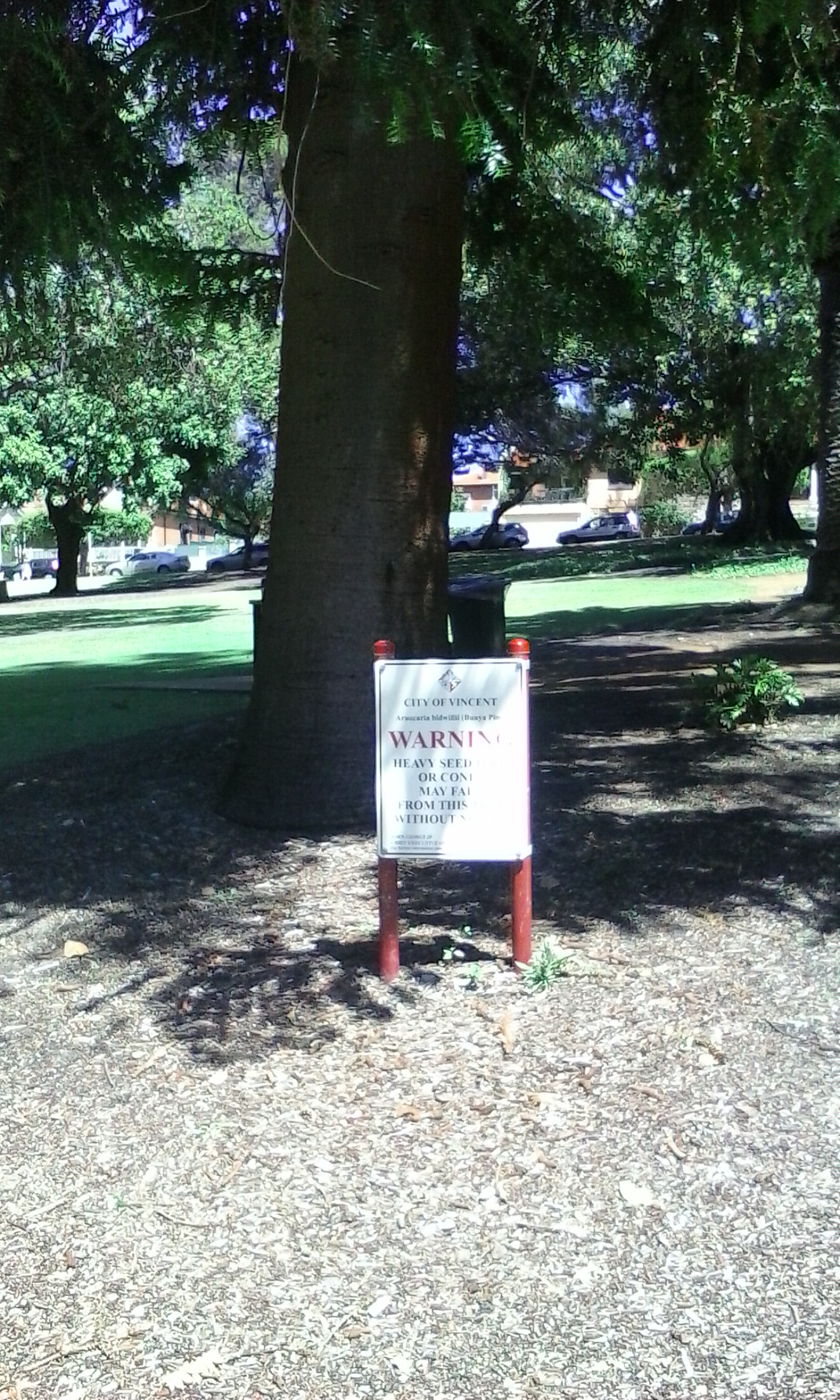
IMG_20141218_101938For instance, I came upon this sign under a tree in Hyde Park. Sadly the photo isn’t clear, but what the sign actually says is, ‘Heavy seeds or cones may fall from this tree without notice’ Without notice, mind! Bloody trees: no consideration. The sign itself would be unusual for a country that isn’t generally all that bothered about health and safety regulation.

I never did get around to taking a photo of the bins they have for dog owners to dispose of their little plastic bags, which is a shame, because I don’t suppose many people will believe me when I tell them that they’re labelled ‘Doggy Dumpage’. Only the Australians could make something so quotidian and unpleasant so much fun.

IMG_20141212_174016Something else I never got my head around is these signs in IGA (one of the main supermarket chains). I can’t help thinking I’m missing something, and perhaps I should have asked one of the assistants for an explanation, but it looks to me like the special offer gets you 3 mangoes for five bucks, instead of the $4.98 you would have paid if you bought them individually. Like I say, perhaps I’m missing something, but I like to think it’s the manager having a bit of fun with their customers. The mangoes were tasty, in any case.

I also love the way that Australian shops price everything at $x.99, but when you come to pay they round it up to the nearest dollar anyway. So if you pick up something priced at $4.99 and take it to the till, you’ll hear, ‘that’s five bucks then mate.’ It took me a while to get used to that, too.

The language in Australia makes me smile. Three of the most used words are; ‘look’, ‘yeah’, and ‘aw’, as in the standard opening gambit of, ‘aw… yeah look…’ The word ‘look’ is seriously over used. It must be very frustrating for anyone who’s blind.
The standard greeting, particularly in shops, is ‘How ‘ya going?’ (or, ‘How ‘ya going, guys’, when speaking to more than one person). It’s best not to say ‘pretty regularly at the moment as it happens, not that it’s any of your business’. The correct response, as far as I could work out, is ‘Good.’ or ‘Good, thanks.’ or, if you’re feeling particularly effusive, ‘Aw..yeah, look I’m good, thanks; how are yoo-oou?’

I didn’t get as much writing done as I’d hoped while I was away – too many distractions maybe? I’d hoped to make great progress on those long flights, but the environment wasn’t really conducive – too uncomfortable, too distracting looking ahead at rows and rows of flickering television screens. I did manage to knock out a short story, based on a news item about a property development – a multi-million dollar mansion in an affluent suburb of Perth – that had run into difficulties and was due to be demolished. And I did cover all of the research that I’d wanted to do for the novel. At least I think I did. Then again, now I think about it, I’m not so sure. Maybe I’d better go back again, just to check…

Posted in Writing | Tagged , , , | Leave a comment

Writers’ Forum (or against ’em?)

One morning last week I bunked off work to attend a writers’ forum, held as part of the Penarth Book Festival (watch out Hay!) The presenter was Phil Carradice, a Welsh author and poet with over fifty books behind him. Actually, I’ve got over fifty books behind me. But then I am writing this in a library. It was a useful and informative event, even if we were told ‘you’ll never make a living out of writing!’ Ouch! Don’t hold back Phil; tell us how it is. Apparently most authors make their money from associated activities such as readings, seminars and teaching. Phil also does radio work (he’s on the BBC website) and, occasionally, television. These peripheral activities generate a large part of a writer’s income, and also provide opportunities to promote book sales. He stressed how much hard work is involved. He also stressed how difficult it is to get a publisher, and how picky publishers are and how much they expect from all but the most famous authors. You might think from this that he had a very low opinion of publishers. You might think this, but I couldn’t possibly comment.

None of this bad news came as much of a surprise, but it was probably worth hearing it again. There is a tendency to push this kind of unwelcome knowledge to the back of your mind and replace it with the hope that you might one day snare one of the major publishers, persuade them to give your book their full attention, and thereby move straight into the upper echelons (and income group) of the writing world. It does happen, and as Phil said, you have to believe in your work and say that if it happens, why shouldn’t it happen to me? One day, perhaps. In the meantime, he had lots of tips on how to promote your work, using local connections and networks to get started, to develop a reputation that can be built upon.

Phil read out one of his short stories, ostensibly by way of explaining a point about how short stories should be structured, but actually, I think he just wanted to do it. I’m not complaining. It was a very good, well-written story, which distinguished him from at least one Cardiff author, who for some reason thinks they are suitably qualified to teach other people to write (bitchy, I know, but at least I didn’t mention a name). He has a good, strong voice, and reads very well, I suppose through practice (he was a teacher, which probably helps). Impressive, but daunting. Could I hope to read so well? Could I command the attention of a room full of people right to the end of a story? It would help if I had a good voice to make use of, rather than sounding like Ken Livingstone on a quiet day. I came away with a lot to think about. My primary activity remains to continue writing novels and presenting them to publishers and agents in the best way I can. I’m aware of the need to make my submissions stand out, to make the concept attractive to publishers,  giving the writing a chance to sell itself. I should probably make an effort to hunt out the local writing scene (assuming there is one) and see if I can somehow get involved, make some contacts, etc. You know, I thought this writing malarkey was a lonely business. If I’d known it involved dealing with people, I might have thought twice…


Posted in Writing | Tagged | Leave a comment

Would you Pay for Feedback?

Feedback01 October 2014

I’m in the middle of a spate of submitting stories to competitions. All of the competitions I’ve identified charge a fee for each story submitted, which I suppose is fair – they need to cover their costs. Some of them offer a feedback service, for which they also charge. I’m not so sure this is fair. The feedback takes the format of the marks that the judges award for plot, character development, etc., plus some text outlining their thoughts on the story. What you get is essentially the assessment of your story that the judges will have prepared anyway (assuming they judge the competition in a properly structured and documented way). The charges are not excessive (as an example, one of the competitions charge AUS $10 to enter a story, and another AUS $15 for feedback). But if you enter a number of competitions, the charges will soon add up. For someone on a low income (such as yours truly) it’s difficult to justify paying the extra. Then again, I’m sure the feedback would be useful. Although.., actually, I’m not. The stories I’ve written (and I’ve mostly written a new story specifically for each competition) are in a variety of styles and have different structures and subject matter, which makes me think that the feedback might be inconsistent and difficult to apply more generally. Although, if I were to see some  consistent criticism across such diverse writing, it would be fairly persuasive.

Writing all these short stories has slowed progress on my second novel. It’s frustrating, but it will be worth it if I have success in some of the competitions. Theoretically, it could be a good way to get some of my work published and have something to put on my CV. Although I’m not holding out too much hope – my first two entries got nowhere!  I hate stopping work on the novel. Within a day of putting it down I feel as though it’s beginning to drift away from me. And when I start work again there’s a process of re-acquaintance that takes valuable time – like taking two steps back before I can take three forward. I am progressing though. I’m up to nearly 40,000 words now, and foreseeing the time when I will need to do some significant editing to cut it down to a more manageable size. Established authors may be able to get away with epic novels, but publishers seem to want and expect something under 100,000 words from new writers.

Anyway, what would you do about the feedback; save your pennies and hope your story is selected (which is all the feedback you need) or stump up the cash for feedback in case it isn’t?


Posted in Writing | Tagged , , , | Leave a comment

At Cross Purposes…

Hat03The British Legion sent me this cross. I like the British Legion. They’re a worthy charity, and they do valuable work, including providing social clubs for millions of people across the country (even if many of those clubs are in decline). It’s just; why did they have to send me a cross? They want me to write a message on it, send it back to them and they’ll include it in the field of remembrance at Cardiff castle. To commemorate those who fought, and in many cases died on our behalf. But what did they fight for, our selfless ancestors, friends, relatives? Surely it was freedom. Freedom from tyranny and oppression, freedom to enjoy basic human rights such as freedom of thought and freedom of speech. And freedom of belief. But the British Legion don’t seem to understand this. According to their leaflet they have other remembrance tribute options available, such as a crescent or a star. Presumably they have an option for those who aren’t religious. You have to phone them though, to find out about these, and to have them send you one specially. Because the British Legion made the decision to send a cross, a Christian cross, to everyone – a lazy assumption that we are all, by default, Christians, unless we speak up and tell them otherwise. For all they knew I could have been a Muslim or a Jew, or a member of the Church of the Flying Spaghetti Monster. As it happens, I’m an atheist.

After WW1, the Imperial War Graves Commission insisted on a standard, non-denominational headstone for war graves, in order to reflect the equality of death.(1) It seems that some people have learned nothing. The British Legion could have stuck with the inclusive image of the poppy for remembrance. But no doubt those that run the organisation are Christians, and saw no reason not to use a Christian symbol; no reason not to perpetuate the ongoing insidious, subliminal indoctrination that we encounter everywhere in our daily lives.

So the cross is still sitting there on my sideboard, a small insult, a symbol of religious oppression, yet another attempt to make me feel an outsider in my own land; a subtle suggestion of the establishment’s disapproval of my beliefs. As usual, I expect to mark the 11th November with my own personal thoughts, ignoring the religious ceremonies imposed on the nation by our government and the established churches. As for the cross, I’ll probably use it for kindling (as I don’t have any bibles left…)

1. Source: http://www.archaeologyuk.org/ba/ba109/feat4.shtml

Posted in Religion | Tagged | Leave a comment

Where have all the trees gone…?

Dead trees

The green revolution starts at home. Or at least it should. The reality is, we’re going in the wrong direction. Every week now, as I walk, cycle, or drive around my neighbourhood I see more gardens being denuded of plant life. In spring, summer, autumn and winter, suburbia is alive with the sound of chainsaws. Mature trees that have been growing for decades or even centuries are routinely felled on the whim of a householder who thinks it might be nice to have a bit more light in the house, a bit more sun in the garden. Houses are bought and sold, and so often the new owner sends in a team of landscape ‘gardeners’ to change the garden into an ‘outside space’, which means raising it to the ground and replacing the greenery with decking and patios, barbeque areas and hot tubs, sterile wastelands of bamboo.

It’s not even just the gardens. Every year the Council has the street trees pruned to within an inch of their life, for fear that a falling branch might lead to a claim for compensation, and at the slightest suggestion of disease, they have them felled, the stumps ground out and the resultant hole quickly tarmac’ed over. They never think of replacing the ones they take out. Perhaps they know from experience that any new trees would have to be big enough to stop passing drunken idiots snapping their trunks.

Not so long ago domestic gardens were being described as the saviours of wildlife, providing refuges from the deserts of concrete and tarmac, and the chemical soaked wastelands we laughingly refer to as agriculture, which make up the bulk of our fabled green and pleasant land (Fairest Isle; my arse!)

I’d say that I just don’t understand people, but the truth is they don’t understand themselves. Studies have consistently shown that the presence of plants, and particularly trees, is beneficial to human well-being, and that their absence is detrimental, and yet people don’t seem to understand this. They think that they don’t like plants, that they prefer concrete and brick. They think that plants are a nuisance, that they obscure their view, get in the way of their cars, reduce the space available for a barbeque or hot tub, drop troublesome leaves everywhere and take too much time and money to maintain. Do they really not understand that plants absorb carbon dioxide and traffic pollution, and in return give us back fresh, clean oxygen, which we all need in order to live? And that however much people might insist “Oh no, I’m a city person at heart, I can’t be doing with all that green stuff” the absence of trees, plants, parks and green spaces is as detrimental to their health and their state of mind as it is to the environment.


Posted in Environment | Tagged | Leave a comment

Isn’t the right to self-determination important?

Once again a bill to allow assisted dying is being put before parliament. And once again the churches are using the full weight of their power and privilege to lobby; to bully MP’s into rejecting it. And because of this, and because religious representation in parliament is so out of proportion to the level of religiosity in the population as a whole, it seems likely that this bill, like all of its predecessors, will be voted down. The role of MP’s is to represent the people. Surveys have consistently shown that around eighty percent of the population are in favour of assisted dying, but most MP’s pay no heed, simply vote according to their own consciences (which tell them that their own religious beliefs, along with keeping the powerful religious lobby happy, are more important than doing what their constituents ask of them).

I would argue that popularity isn’t actually relevant in this issue, because the granting or withholding of a right should be determined not by its popularity, but by its reasonableness. To illustrate this point I would ask you to consider whether if eighty percent of the population thought that we shouldn’t read books, it would be reasonable to burn all the books and make reading a crime. People can choose whether they want to read or not; those that don’t want to don’t have to, those that do can, and cause no harm to anyone by doing so. It’s the same with assisted dying, which is essentially the right to self-determination. It might be that very few people ever want to make use of this right, but it should still be there for those who want it. Religious representatives have the right to tell us if the tenets of their religion hold that to take a life is wrong, regardless of the situation (although this is down to individual interpretation of ancient texts). But when they try to enshrine their religious ideas into secular law, they must  be stopped.

Self-determination, an essential part of which is the right to choose not to live, is as important a right as the right to life. Of course, this doesn’t mean that we should do nothing to stop someone from trying to kill themselves, particularly if it’s just because they’re having a bad day. We have a responsibility to help our fellow human beings in times of trouble. For instance suicide (which we should remember is thankfully no longer classed as a crime) is often driven by depression, which is almost always a transient state. Where someone is feeling suicidal due to depression we have a moral obligation to do what we can to show them that the condition will pass, that they have the potential to live a full and happy life. But ultimately, if we fail, can we deny them the right to self-determination?

The idea of assisted dying is to give someone who is in dire circumstances, and who is incapable of ending their life by themselves, the right to have someone else do it for them. All of the bills that have been presented have ensured that there would be proper safeguards in place. The church would have us believe such legislation could be used by unscrupulous people to rid themselves of disabled or elderly relatives who are a burden to them. This is an under-hand tactic and is clearly nonsense. The legislation – the human right – is for those whose quality of life is so deteriorated as to make life not worth living. It’s for people who may be suffering terrible pain, whose condition may be terminal, irreversible; who in all probability will only deteriorate further, suffer ever worse pain, become ever more debilitated, ever more humiliated by their condition. How can we reasonably withhold from these people the right to end their suffering; the right to self-determination? This is not ‘Christian’, it’s inhuman.

Posted in Ethics, Politics | Tagged | Leave a comment

Religious schools are the problem

I’m not surprised that Michael Gove’s free school program has run into difficulties. The focus of discontent has so far been limited to fundamentalist (i.e., extreme) Muslim schools. It’s easy to see the danger of allowing a school to be run by people who may hold backward, harmful views about issues such as the right to equality for women or homosexuals, or even for people who hold other beliefs. But the problem is wider than that. We need to teach children to think for themselves, rather than force-feeding them world views that are subjective, limited, and in many cases harmful and abusive. Religious schools deprive kids of a basic human right – the right to freedom of belief, which requires an open mind and free access to information and ideas. Religious schools segregate children and emphasise the differences between people, rather than their similarities, and foster alienation, disdain and even hatred.

It’s right that religion should be taught in schools. After all, it’s probably been around for as long as there have been societies, and in almost all of those societies it has exerted a very strong (and often very harmful) influence. In all societies around the world religion is still (unfortunately, in my view) adhered to by a significant proportion of the population, and still exerts a powerful influence. Religion (or rather religions, in the plural) are a part of our culture and a part of our history. However they should be taught objectively, not subjectively, in an atmosphere of openness, where children feel able to ask questions, to be critical and so, over time, develop their own world view. At present, this doesn’t usually  happen. Instead, generation after generation of children are sent to schools where they’re brain-washed into accepting the religious beliefs of their parents. It’s very interesting, and rather damning of the credibility of religion, that despite this so many of them grow up rejecting those beliefs.

Posted in Religion | Tagged | Leave a comment

Theremin Trap

I don’t intend to write film reviews on a regular basis, but I’ve been inspired to write one now by a film that I saw at the weekend, called ‘Frank’. It’s a dark, funny and very unusual film, which was inspired by, but not based on, Chris Sievey, a Manchester comedian  and musician. Sievey created the character of Frank Sidebottom, for which he wore a rather disconcerting papier mache head. In the film, the character of Frank has a band (as did Frank Sidebottom) but the noise they make is rather harder than the real Frank Sidebottom’s synth-based pop parodies.

For many years now I’ve listened almost exclusively to music by the likes of Haydn, Vivaldi, Handel and Tallis. Partly it’s because this is the music that I love. Partly, it’s because I got bored with contemporary music. It got to the stage where I felt that I wasn’t hearing anything new. Every new band, however far from the mainstream (and I did like them far from the mainstream) sounded as though they were just mixing and matching elements of what had gone before. I couldn’t find anything that was really convincing. Perhaps, then, I imagined the reality was that there had never been anything convincing; I’d simply grown up, musically speaking, and come to see the young people’s simplistic attempts at originality as pretentious and unsuccessful.

But then I was sitting in the cinema on Sunday evening, as the scene in the film, where the band begin a disastrous and prematurely ended set, played. And their mad, chaotic, cacophonous sound whacked me round the head so hard that it sent me back to my youth. Just for a moment I was listening once more to music that was important, portentous; music that made you see that the world isn’t what you think it is. It was just a short piece of music, before the PA blew up and the band set about each other, but it reminded me of something that has been missing for a long time.

The star of the band is not the singer with the frightening false head and a talent for unusual lyrics, but Maggie Gyllenhaal’s crazed, knife-wielding Theremin player. When the new recruit, a geeky and ultimately divisive character, shows an interest in, and approaches the instrument, she takes a swipe at him and snarls, ‘Keep away from my FUCKING Theremin!’

The film led me along, not knowing what might happen next, which of the characters (if any) I should be routing for, not knowing which of the characters, never mind the band itself, would be able to hold it all together and which were sure to self-destruct. It’s largely a film about mental illness. It’s also about the difference between the ability to cope and the inability to cope, which is arguably nothing more than a matter of perception. It said to me that there are people in the world who, when allowed to do things in their own unusual way, are able not just to cope with life, but to excel. But if you push conventionality upon them, force them to operate within the standard, accepted ways, they are liable to fall apart. And I should know, because this is me, albeit in a fortunately rather less extreme version.

All I can say is that if you only see one film this year, you really need to see more films…

Posted in reviews, Uncategorized | Tagged | Leave a comment