
I’m in Cadiz, in Andalucia, and there are a few interesting bookshops that have caught my eye. This one is named for the famous composer, Manuel De Falla, who was from Cadiz (and according to the plaque on the wall, was born in the house next door).

Books, books, everywhere, and barely a word to read…
MOBO – Playing on the black notes

The MOBOs (Music of Black Origin awards) have come round again. Another chance to acknowledge the achievements of artists in a number of musical genres. Or, looking at it another way, is it just another chance for an unthinking media to celebrate shameless racism?
What is the MOBOs intended function, and how can it be justified? Is it positive discrimination, designed to give a boost to talented black artists? In which case, are we really to believe that black artists don’t get equal opportunities in popular music? Or is it more about ownership – an attempt to annexe the bulk of popular music for black people, or communities? According to its website, the MOBO organisation…
‘…was established to recognise the outstanding achievements of artists who perform music in genres ranging from Gospel, Jazz, RnB, Soul, Reggae to Hip Hop. Over the past 20 years, MOBO has played an instrumental role in elevating black music and culture to mainstream popular status in the UK.’
Doesn’t sound too sinister, does it? And the genres they mention (with the exception, arguably, of jazz) have all been dominated by black people, and probably originated within black communities. But is it right to say that ownership for those genres, and others, rests with black people? What music influenced the people that were the originators of the genres MOBO mention – ‘black’, European, Middle-Eastern, Jewish, East-European, Indian, Chinese? At what point did certain strands in the long evolution of the music of Homo sapiens become purely ‘black’? And how can self-appointed representatives of the black community (whatever that is) justify claiming as their own strands of music which in their long evolution have seen contributions from people of various ethnicities? There have been so many successful black artists in popular music, from the early twentieth century onwards. People from black communities (as well as some people who happened to be black but didn’t see themselves as belonging to a particular community) have been influential in so many popular musical genres. But does that allow black people as a group (which they’re not) to take ownership of a large proportion of popular music? Even if we accept for a moment that music can pertain exclusively to people who are black, white, or some other racial denomination, how can you successfully decide whether a particular piece of music is of ‘black origin’, and what does that actually mean?
You might argue that the fact the MOBO’s include white musicians means that they can’t be racist. In some ways, I think this makes it worse, not better, because it’s a kind of condescension. Being nominated for a MOBO, if you’re not black, must seem like a bit of a back-handed compliment – a bit like being told that your music isn’t your own; that you just re-worked music that had originated with (much more talented) black musicians.
The obvious test to check whether it might be acceptable to limit access or ownership by skin colour (or race, or gender, age, etc.) is to try substituting an opposite, or different group, and see if it still sounds alright. Would the MOWOs be covered on mainstream television, or reported favourably in the newspapers? Perhaps some of the classical awards could be re-branded as ‘Music of White Origin’ – it would be difficult to argue that the description isn’t accurate. Except that it’s the last thing the classical establishment would want, when it’s trying to break out from its exclusivity and increase diversity in classical music. If the MOBO organisation really wants to promote equal opportunities, perhaps it could sign up to help. Which brings us to the most pernicious effect of MOBO, which is not that they’re trying to snatch ownership of large swathes of popular music from the general population, so much as that they promulgate a kind of coercive segregation for black people. They direct black people towards certain types of music, they say ‘this is your music – don’t listen to other types of music; they’re not for you.’ Music is (or should be) for everyone. With its focus on skin colour, MOBO sullies the purity of music.
I don’t suppose the people behind the MOBO’s are at all malicious, or that they’re involved in some sort of racial conspiracy. I suspect it’s more a lazy, unthinking kind of racism – someone having an idea and following it through without thinking what it really means. But does that mean we should let it go? Racist attitudes often start small but, if left unchecked, can grow to frightening proportions. And while most people would see nothing malicious in the MOBOs wrong-headed good intentions, I suspect there are plenty of people out there who are very happy to accept them as justification for their own, rather more damaging racist attitudes.
What makes it so sad is that music is acknowledged as a universal language, which has been so successful in bringing together people from different backgrounds, places, cultures; people with different ideologies; people of different races or skin colours, allowing them to communicate with one another, to ‘harmonise’, to forget their differences and celebrate their similarities. For me, the MOBOs blast all of that to pieces, and split the musical world apart with a huge, nasty wedge of colour prejudice.
So why does the media not see this? There is still so much racism in our society. And we’re never going to fully eradicate racism until we recognise it in its most ironic form – the assumption that you can’t be guilty of it if you’re not white.
Editing – Part Two
 I may have had reservations at the start, but I’m getting seriously into this editing malarkey now. I’m really beginning to appreciate the value of clarifying and simplifying what had become a fairly complex set of inter-weaving stories.
It isn’t always easy to delete sentences, or even whole passages, that you may have worked hard over during the writing stage, but I’m being quite ruthless. This has been made easier by the knowledge that the first draft is still there; saved on my hard drive, and on a backup too. However much I cut up and re-work the current version, the first draft will still be there, pristine, unblemished; preserved for posterity. I still have belief in my first draft. I still believe that, aside from a few minor corrections, if all memory of it could be erased from my mind and I were to then read it, I would appreciate it for what it is; a complete and effective novel. And I believe there are many readers out there who would feel the same way were they to read it. But at the same time, I can see where I’ve made mistakes – explained too much, used language that’s too fussy, put in too much detail (or in some cases, not enough). I can see places where I’ve not been clear about the progression of the story, or the purpose that an event, meeting, description or comment plays in it. So I’m confidently re-working, re-writing, cutting (in some cases, cutting out whole sections), secure in the knowledge that it’s all still there, safe and sound in my saved first draft, in the unlikely event that I change my mind.
I’m finding ways, I think, of making the book more slick; easier to follow and understand. I’m reinforcing clues as to what’s going on, and how apparently unrelated scenes interconnect. Maybe I’ll end up making it all too obvious for some readers. I hope not. I’m stream-lining, but I don’t want to make it too easy. I believe that an author shouldn’t do all the work themselves – they need to leave something for the reader to do. I think there are two books. The first is what comes out of my head and lands on the page. The second is what comes off the page and, through subjective interpretation, ends up, reformatted, in the head of the reader. Leastways, that’s how I read (when I get the chance to read; when all my free time isn’t taken up with writing). The printed version of the book belongs to the author, but the interpretation of it belongs to the reader, and is unique to each and every reader.
The editing is taking some time, but I’d rather make sure it’s right than risk compromising the final draft by rushing it. I’m going to be too late for this year’s Man Booker, but this time next year… who knows?
Is Roald Dahl destroying our language?
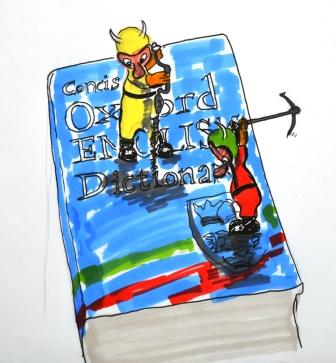
Gremlins are sabotaging the English language!
The latest quarterly update to the Oxford English Dictionary includes made-up words and phrases used by Roald Dahl in his books.
Words like ‘scrumdiddlyumptious’ (which I think is just ‘scrumptious’ with a bit of nonsense filling in the middle, rather than a new way to describe an enjoyable game of rugby) and ‘oompa loompa’. It’s one of those curious co-incidences that at the same time as this was announced, I happened to be reading a book by Richard Dawkins which deals with, amongst other things, the evolution of language. Dawkins suggests that languages evolve in similar ways that living creatures do. Many writers have put made-up words into their books over the years, and I can imagine it must be very satisfying when one or more of your words or phrases find their way into general usage. There are many ways in which languages change, most of which, I think, are the result of people attempting to differentiate themselves from the rest of society. All of the commentary I’ve heard seems to be in the direction of suggesting that a changing language is a living language, and that’s a good thing. Whilst I can see the appeal, I can also see a huge problem.
To illustrate how the English language has changed, Dawkins used a passage by Geoffrey Chaucer, who was writing in the fourteenth century. Chaucer’s text is difficult to understand today. Some of the words have gone out of usage and are unknown to us. The grammar is odd, and the spelling so all over the place that we don’t even recognise some of the words that we know. Half a millennium of language evolution has seriously impeded Chaucer’s ability to communicate with us. With the current accelerated rate of change in language (I’m assuming the rate of change has accelerated, but I think this is likely given the fast pace of change in our society generally) how long will it take for what we are writing today to become gibberish? We understand the value of communication (or we think we do) but we don’t seem to have the foresight to consider the benefit of being able to communicate outside of the present. Do we want to be able to pass on our knowledge, our discoveries, our experiences, our mistakes, our feelings, and the sense of what it is like to live in todays society, to people in the future? In order to do this we would need to fix our language, to stop it from changing, or at least to hold back the rate of change. Then again, new words and ways of speaking often become popular for a while and then fade into obscurity, so perhaps the long-term effect of all this language change is less than it appears.
Isn’t it ironic that by creating new language, as well as adopting new ways of speaking into our writing, writers are effectively making the work of earlier writers obsolete, and that writers in the future will do the same to our work?
I love dictionaries. I can (and regularly do) get lost in them, but even people with much better memories than mine have no chance of remembering even half of the words in the OED. So, do we really need more words? Do we really need ‘scrumdiddlyumptious’, in addition to the more succinct ‘scrumptious’? And if we want to play around with words, aren’t we clever enough to do it ourselves? I’m inclined to be cynical and say that, for dictionary writers, it’s something of a gravy train [informal a situation in which someone can easily make a lot of money] *. Those guys are forever adding new words, but I wonder – do they ever take any out?
*Oxford English Dictionary
How do you edit a novel?
 And how do you motivate yourself to get started?
Continue reading
Book Review – The Establishment…
…And how they get away with it. By Owen Jones.
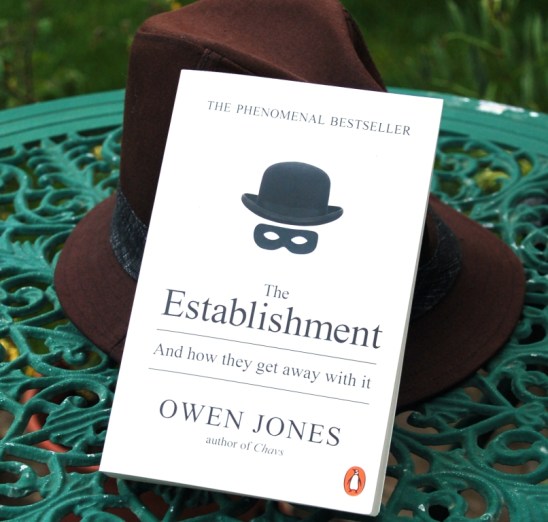
This was not an easy book to read; not calming or uplifting. Jones sets out a tale of how, over the course of more than forty years, an elite, privileged few set about neutralising democracy and helping themselves to power and wealth at the expense of the rest of us.
At a high level, there’s very little in the book that I wasn’t at least vaguely aware of. But Owen Jones has been meticulous in his research; and conducted candid interviews with people who have first-hand experience of the processes and behaviours that the media try so hard to hide from view. Some of the interviewees were victims of the establishment. Others were in positions of power – and some of them still are, and continue to behave in ways that are harmful to society as a whole ( but make which make themselves and their peers ever richer), often with only a limited understanding of the effect their behaviour is having. Jones’ research has teased out a relentless stream of fascinating and infuriating detail. I found it difficult to put the book down, which for a work of non-fiction (if only it were fiction!) is high praise. And yet, despite being addictive, reading it feels just a little bit like self-harm. With each new revelation I found myself thinking ‘wow – I must try to remember that!’ (swiftly followed by ‘I’m not going to remember that!’) So many facts, but it’s all pulled together with great skill.
There are themes running through the book. One is the idea of how the establishment use scapegoats (such as the unemployed, trade unions or immigrants) to direct the public’s attention and anger away from their own nefarious activities. Another is the idea that while corporate interests are constantly chipping away at the state, promoting ever greater cuts in public spending, they themselves are being subsidised from the public purse at a level that actually dwarfs spending on public services. I was struck by his portrayal of those three letters ‘NHS’ having become little more than a logo behind which corporate interests operate, hidden from the view of an unsuspecting public. David Cameron said, I believe, that the NHS was safe in his hands. Owen Jones details the wide-scale of part-privatisations that have in many cases gone unreported.
As someone who follows anti-establishment commentary in preference to the conventional (establishment) media, I thought I knew a bit about the injustices in British society. But in this book I found plenty of revelations. For instance, after Ed Milliband was elected as leader of the Labour party there was a widely held view that they had picked the wrong brother. Owen Jones claims that after losing the election, David Milliband threw all his energy ‘into building an impressive portfolio of business interests’, and that he ‘made around one million pounds between his failed leadership bid in 2010 and his departure from the commons some two-and-a-half years later’. Perhaps Labour chose the right brother after all!
Politicians, the media, the police, big business, the city of London – one by one the groups that hold power and control our lives are shown to be corrupt; driven by self-interest to damage our economy, our environment, our society – who cares, so long as they get ever richer? I’m not sure I should be reading this kind of material. I have a keen sense of injustice – indignation is something I’m rather too good at. But then, Owen Jones’ scientific approach might have helped me to go beyond indignation and become more objective. And after two-hundred-and-ninety-two pages explaining what an unassailable and merciless grip the establishment has on society, he manages to end the book on an optimistic note, telling us how history shows that situations which seem permanent and irreversible can change – and often quite quickly. He suggests ways in which the status quo might be broken, and how we might build a better, fairer society
I’m glad that I’ve finished the book, but I’m also glad that I read it. Everyone should read this book, and it should be part of the school curriculum…
Posted in Politics, reviews, Writing
Tagged Environment, fiction, history, population, reading, research, reviews, writing
Leave a comment
Europe is in Jeremy Corbyn’s hands

It’s Labour dogma that will lose us our place in Europe.
Continue reading
The Devil Rides Ute
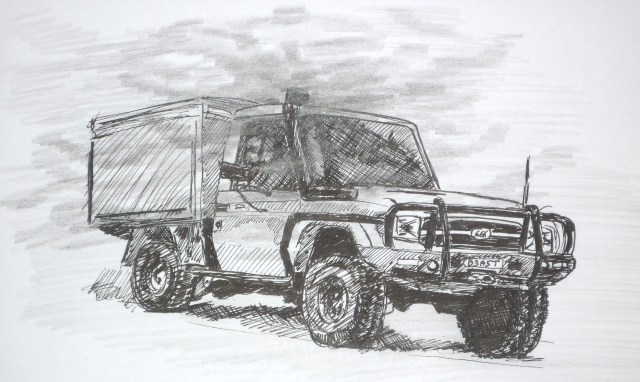 I seem to remember I might have promised (or was it threatened) some more poetry. So here it is, another piece from my sojourn down under, inspired by a monstrous vehicle that trundled past me one day while I was walking to the beach. I didn’t have the presence of mind to whip out my camera and take a photo of the actual, offending vehicle, so the one in the picture is the best I could find some days later (not nearly as large, imposing or frightening as the original subject). Brace yourselves…
The Devil Rides Ute
There is a roar that cannot be purely mechanical;
A grating, rattling, rumble that could come from the belly of a dragon.
It shakes the ground, drawing out a terror presumed long dead.
From out of the subconscious, a materialisation of primeval dread,
And my mind slips, desperate for recognition,
Not wanting to acknowledge this ghoulish apparition,
So paralysed with fear, I can’t turn my head,
Until the monster is almost upon me,
And I’m engulfed in an acrid, black fog,
That chokes, and reeks of generations long dead.
And through the dark, cancerous fumes the monster forms,
White-black, with a presence larger than its worldly size,
White chassis, seen grey through the gloom,
Trimmed all around by black;
Black grill, black glass, vertical black exhaust,
Pumping translucent black fumes into a blue sky,
Black bumpers and bars, black tyres; black heart,
The creature moves slowly; in a world apart,
Floating, not rolling, on black wheels as tall as a man,
Or perhaps just as tall as I feel, shaking as I am with confusion,
Disoriented by this frightening intrusion,
Fearing death, overcome by strife, wondering;
What devil rides inside this affront to life?
More menacing still, unseen behind black glass,
What human mind could conceive to ride inside such a threat,
Such a provocation, that causes others to
Regret the invention of internal combustion? Continue reading
Writer’s Retreat

Why is it that ambition always exceeds the reality of what can be achieved? My writing holiday is now a fast-fading memory, and I’m left wondering how I could have imagined I would have got so much done (see my last post). Continue reading
The Mile High Poets Society
I’d like to share with you a poem that I wrote yesterday, while sitting in an aeroplane somewhere over Southern Europe. I say yesterday, but I can’t be sure of that, having crossed several time zones since then. And I say poem, but it’s actually more like a short piece of descriptive (and rather surreal) prose. But I decided to follow what seems to be the trend at the moment by throwing in a few random line-breaks and calling it a poem. After all, what makes something poetry is the same as what makes something art – the creator (of the work, not the fictional ‘Creator’) saying that it is.
So here goes. …Well, actually, I think I should set the scene first – change the mood from flippant to something more serious. So imagine me in full imaginative flow, gazing out of the window, all starry-eyed, at the beautiful cloudscape below (yes below, and not above). I’m on my way to Singapore, for a few days, and then on to my adopted home-from-home, Australia, and a few weeks spent mostly in beautiful, elemental natural environments – deserted beaches, bush-land teeming with exotic wildlife and, hopefully, some lovely warm weather. I’m going to walk, swim, relax, sketch and, most importantly; write. Perhaps I’m expecting too much from myself, but I’m hoping to complete a first draft of my novel, knock out a few short stories, and perhaps dream myself into some poems too. Absolutely no pressure. But I’ve made a start already. Whether it’s a good start or not, I’ll leave for you to judge.
The Plains of Heaven
A landscape of low white peaks and soft grey shadows extends away into the distance.
The horizon is a band of white,
Evaporating up into ever deepening blue.
Impenetrable cloud, like deep snow on solid ground,
But cotton-wool soft: a soft-toy Antarctic landscape.
I want to get out, I want to fall from this aeroplane,
To plummet through the air into a duvet-soft landing.
I feel as though the cloud must be able to hold me, to welcome me;
To embrace me into the purity of a world untainted by people, unsullied by life.
There’s silence, and stillness, and alone at last,
I lie on my back, cosseted; at peace.
I could stand up, walk, take one leaping step after another,
Bound moon-like across the endless plateau,
Entranced, indefatigable, bouncing along, happy now;
Joyous in the reborn innocence of childhood.
But it’s so comfortable just lying still in my cotton-wool womb.
I can’t bear to move.
My eyelids feel heavy; they close,
The whiteness engulfs me and I fall asleep.
Note: The plains of Heaven is the title of a painting by John Martin , a nineteenth century artist who specialised in very large canvases showing immense landscapes, seascapes, skyscapes; detailed, intense stunning works. Of course, he was working before aeroplanes had been invented, so he could only imagine what I was fortunate enough to experience


 literarylad