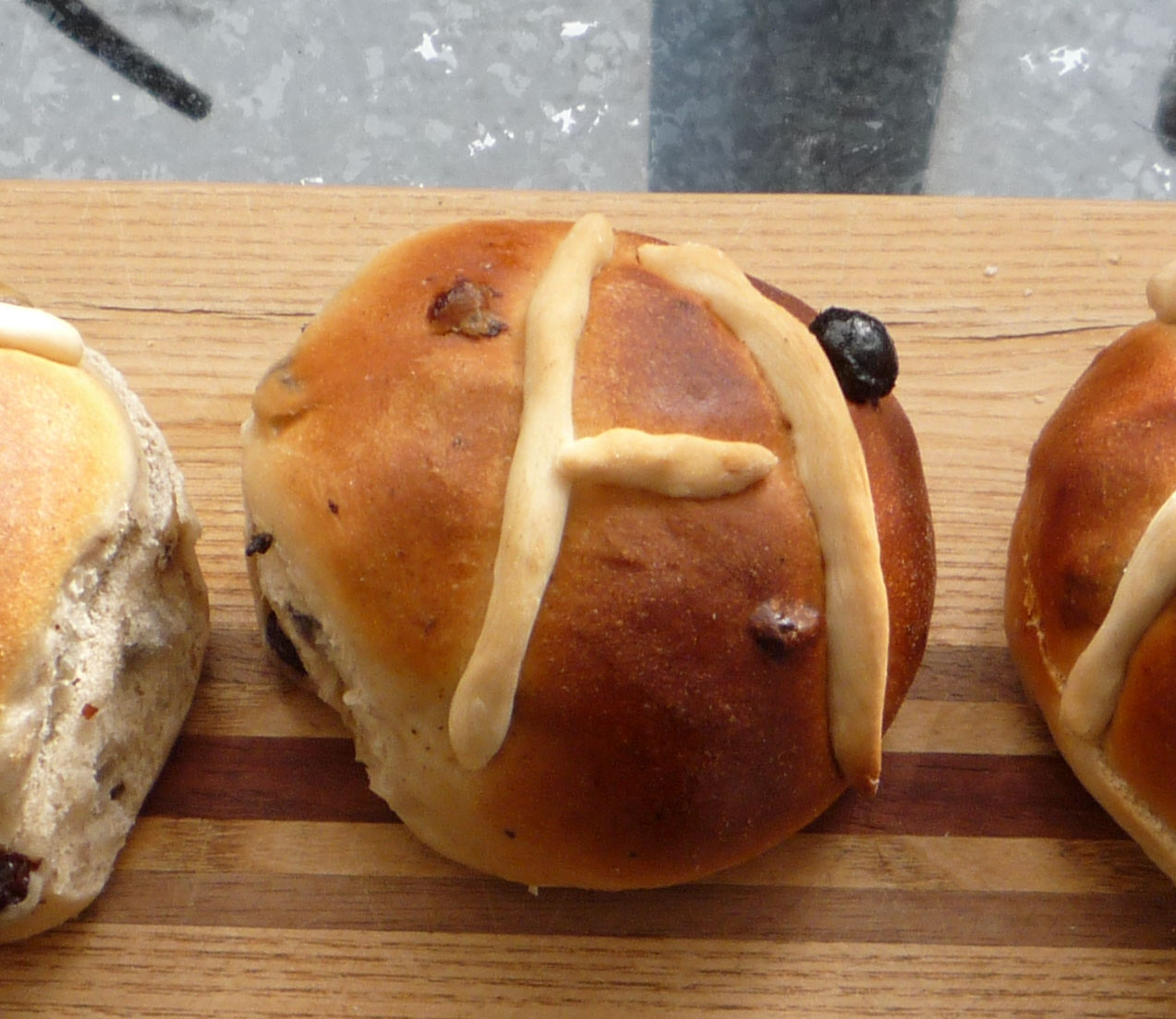
Why should god have all the best buns?

Atheist Bun02Hmm, hot cross buns. Or as us secularists like to call them; tea cakes. Here in the literary lad household we’re not religious, but we do rather like the Easter bunny, who died on Watership down to save us all, and was resurrected in the sure and certain hope that children everywhere (well, at least in the developed world) will always have lots of lovely chocolate to eat.  (I may have got a bit confused over some of the details; myths are not really my strong point). He may not have brought us a message of importance regarding the meaning of life (although, hang on a minute; chocolate…) but he has got a cute little cotton tail and soft, fluffy ears.

I’ve become increasingly uneasy about the symbolism of the cross on my buns in recent years. At the same time, however, I very much like hot cross buns. The solution came to me in a moment of inspiration: use a different symbol. There’s no law that says it has to be a cross. As you can see from the picture, I chose an ‘A’ for Atheist, as that represents my own personal belief system. But you could put whatever you like on them really. A crescent – if you’re a Muslim –  the initial letter of your name, CND logo, smiley face, Bauhaus face; the choice is limited only by your own imagination. I can see a new tradition taking off, where every Easter people compete to create the bun with the most original symbol.

I don’t see why we shouldn’t take the best bits of religious tradition and change them to fit the modern, secular age. I’m sure there are lots of other traditions I could change. Maybe people could take part in Lent by giving up believing in god? Why not combine Diwali with Guy Fawkes to shine a light on corruption amongst MPs and give them a firework up their backsides at the same time? At Christmas, instead of celebrating the alleged birth of a character in Christian mythology, we could just buy each other lots of presents, eat far too much and get drunk. Oh no; that’s been done already…

Note:  Buns courtesy of Mrs Literarylad (and yes; they were very tasty thank you).

Posted in Religion | Tagged , , | Leave a comment

News from the muse

They say the pen is mightier than the sword, but would you like to go into battle against a Claymore wielding Scotsman if you were armed with nothing more than a Bic? I suppose you might be able to poke him in the eye with it before he managed to strike.

I seem to be writing my second novel one page at a time. Not through choice; it just seems to be happening that way. I’ve been squeezing in a bit of writing in my lunch break and last thing at night, when all I can manage is a page at most. I’m worried that I’m going to end up with something disjointed. I remember reading J G Ballard’s ‘The Atrocity Exhibition’, which is divided up into short sections. It reads as though he wrote the book, then cut it up into individual paragraphs (this would have been in the days when cut and paste was a literal term) gave each paragraph a title and then re-arranged them in random order. Bearing in mind that Ballard’s books are pretty wacky to start with, the result was bizarre, and difficult to follow. Interesting though the experience was, I don’t really want to emulate it. I keep thinking that I’m going to be able to spend whole mornings, or even whole days writing, but mostly that’s all it is – imaginings. Still, I think I’m making progress all the same. I’m up to nearly 40,000 words at the moment. The two main characters are well established, and I’m busy furnishing their world with subsidiary characters for them to interact with. It’s a bit like playing god now that I come to think about it. What does that say about me?

Alex was the subject of the first book, in which he had a rather difficult time. He gets off to a shaky start in this one too, but things are looking much better for him just at the moment. Not so for the new character, Maya. She doesn’t make things easy for herself. She’s a strange fish (but then she’s a writer, so what should I expect?) I’m enjoying writing for her though. She’s got some odd ideas, she doesn’t behave how you might expect, and she has an unconventional relationship with the truth. I think her heart’s in the right place, but I’m concerned that she might do something unexpected at any moment. So far, the two mains have bounced off one another a couple of times, with less than comfortable results. I like to tell myself that they might end up getting together and living happily, like her out of Jane Austen and that Colin Firth bloke, but I know that would be too dull. The reality is, anything could happen. Watch this space.

Oh my god, he’s got a pen; he’s got a pen..!


Posted in Writing | Tagged , | Leave a comment

Hanif you think creative writing courses are a waste of time…

Apparently Hanif Kureishi does. Which makes me wonder why he runs one, and why anyone would want to attend it!

I admit that I have some sympathy with his viewpoint. I think there are a number of problems with teaching creative writing. The first is that fiction, like painting, sculpture, etc., is art, and the value of a piece of writing is therefore, to a certain extent, subjective. Creativity seems to me to be instinctive. You can teach the basics of grammar. You can teach writers to think about continuity and accuracy, to make sure that when they are describing a city they get the landmarks in the right places, to make sure that when they set a scene at eight o’clock in the evening in midsummer they don’t try and tell the reader that it’s dark. These things are important. Every time you get them wrong you remind your readers that what they’re reading isn’t real – it’s been made up by you. You can teach style; analyse the different styles that are used by writers. The trouble here I suspect is that teachers tend to be dictatorial – they tell students which styles are good and which are bad, and direct them to write in a style that they think is current – fashionable – rather than showing them what can be done and encouraging them to develop their own style.

For me, one of the biggest problems with these courses is that I’m autodidactic – I tend to learn best when I teach myself. This has advantages and disadvantages. It can mean that I miss things that I would have picked up had I been taught by a good teacher. On the other hand, I think it makes me more creative, because I’m following my own path. Though this doesn’t work for everyone. It seems to me that a lot of new writers do nothing but ape the writing of authors they read – clichés and mistakes are sucked in from the donor author and spat out onto the page of their own masterpiece-in-progress. Almost every commentator tells us that if we want to become good writers we should read and read and read. While it helps to have read widely, personally I like to keep my distance from other peoples’ books while I’m working on my own, to avoid being influenced.

Perhaps the biggest problem is finding a good teacher. Sometimes very successful authors run courses because they have a passion for teaching and they want to pass on their experience. I suspect more often than not creative writing teachers are authors who have had limited success and are teaching to try and make up their income, or to bolster their self-esteem (like the fictional Ed Reardon). I nearly signed up to a course at the end of last year. It was run by a published author, at a reputable college. At the last minute I thought that I ought to try and have a look at the tutor’s writing. So I found one of their books on Amazon, clicked on ‘look inside’ and started reading. I managed about four pages. I asked Mrs Literarylad to have a look. She lasted two pages! We both agreed it was rubbish. The style and the language was irritating, and the central premise of the book just wasn’t credible (so much for the design cycle!) And the grammar weren’t great neither. And so, of course, I gave it a miss. It might seem arrogant, but I thought; ‘what can this person possibly teach me (or anyone) about writing?’

There is, I think, one major advantage to creative writing courses and qualifications – agents and publishers love them. So however pointless they might seem, they probably do increase your chances of getting published. It depends upon the course you choose. There’s a guy who runs courses at Bute Park in Cardiff (http://parkwrite.wordpress.com/). I can’t tell you whether he’s any good, because I’ve not been on any of his courses, but what he writes on his blog suggests to me that he probably is. His courses are good value for money, and he likes to work with ordinary working class people and the unemployed, which shows integrity. He has been very dismissive of Curtis Brown, who also run courses, but who charge something like £1600. I respect his viewpoint. I too am sceptical about the quality of these courses. However, Curtis Brown are a large literary agency, and by enrolling on one of their courses you are putting yourself in their way. If you are a good writer, it’s a way of getting noticed, though there’s still an element of luck. And of course being good isn’t enough – you need to be able to produce the kind of work that they want; to match their subjective view of what a good novel should be. And £1600 is a lot of dough to lash out when you don’t earn much! I doubt they make much profit on the courses mind, even at that price. I’d rather they spent more time and effort on their slush pile. I’m probably being unfair, but I can’t help thinking that their creative writing school might be something of a factory for turning out identikit writers in their preferred mould. But I’m prepared to be persuaded otherwise. Perhaps I should start saving my pennies…

Posted in Writing | Tagged | Leave a comment

How to get ahead in self-publishing

I’ve been doing some more research into self-publishing, and the amount of work involved, particularly in promoting and selling your book yourself, is daunting. One website (www.writersservices.com – has anyone had any experience of using them?) says ‘resolve to allocate one day each week to ringing round, writing letters and working to get your book into the marketplace.’ This reminded me of an interview I read, many years ago, with a successful band (‘The Icicle Works’). When asked what aspiring bands needed to do to get on, their advice was to do what they had done and give up the day job, because it’s just not possible to become successful while working around a full-time job. However, it’s a brave writer (or musician) who gives up their job to concentrate on their creative career, bearing in mind the low success rate amongst aspiring artists.

What’s also daunting, in addition to the problem of how to find sufficient time after earning a living, doing all those necessary chores and fitting in some time for relaxation, is coping with the actual work of self-promotion. I may well have touched on this before, but it seems to me that what’s required is two very different, and often mutually exclusive skill sets. Self-promotion requires an out-going personality and self-confidence. It requires a great deal of sociability – having a large network of friends and contacts. It requires people skills. The right person for the job will spend most of their time talking, corresponding and generally connecting with people; they’ll thrive on noise and external stimuli.

A typical writer, I would suggest, is someone who is quiet and introspective; the kind of person who observes, rather than interacting directly. The personality profile for a writer would be someone with an active (probably over-active) imagination; someone who spends a lot of time alone, quietly thinking and working on ideas. Constant noise, constant interaction, stifles a writer, because it gives them no room to think.

Reconciling these two different sets of requirements is very difficult. There will be some people who are good at both, but I would suggest they are in a minority. I suppose this explains the traditional relationship between a writer and an agent or publisher – one does the writing, the other deals with the promotion.  Except that it seems to have become increasingly difficult to get an agent or publisher. There are too many people writing; too much competition, and publishers and agents have too little time to look for new talent. And so, we take advantage of new technology, like electronic publishing, to bypass the publishing industry. Which is fine, except that we then have to deal with the tricky problem of how to promote our work…

I don’t suppose there are any out-going, confident people out there who fancy trying their hand at being an agent and want to team up with a talented but introverted writer? Hey, I said talented – maybe I’m more confident than I realise…

Posted in Writing | Tagged , | 1 Comment

A scent of success?

I sent sample chapters of my novel to quite a few publishers last year, without any success, or so I had thought. But then, last week, I had a request from one of them for the full manuscript. I knew not to get too exited; that this was no guarantee that they would offer to publish the book and, sure enough, a few days later I received a message saying that although they liked the book they didn’t think it was right for them. Despite the eventual rejection, it made me feel quite positive. I had a few days of hope. It also focussed my mind on what I might need to do next, once I have found a publisher – what they will expect of me and how I might live up to those expectations. And it gave me renewed confidence in my writing. This was the first feedback I’ve received from a publisher and it was very positive, both about the narrative and the characters.

So, no publishing contract just yet, but I’m going to renew my efforts to get one.

Link to Single Point Perspective on Amazon.com

Link to Single Point Perspective on Amazon.com

Posted in Writing | Tagged | 2 Comments

Ragnarok – hit or myth?

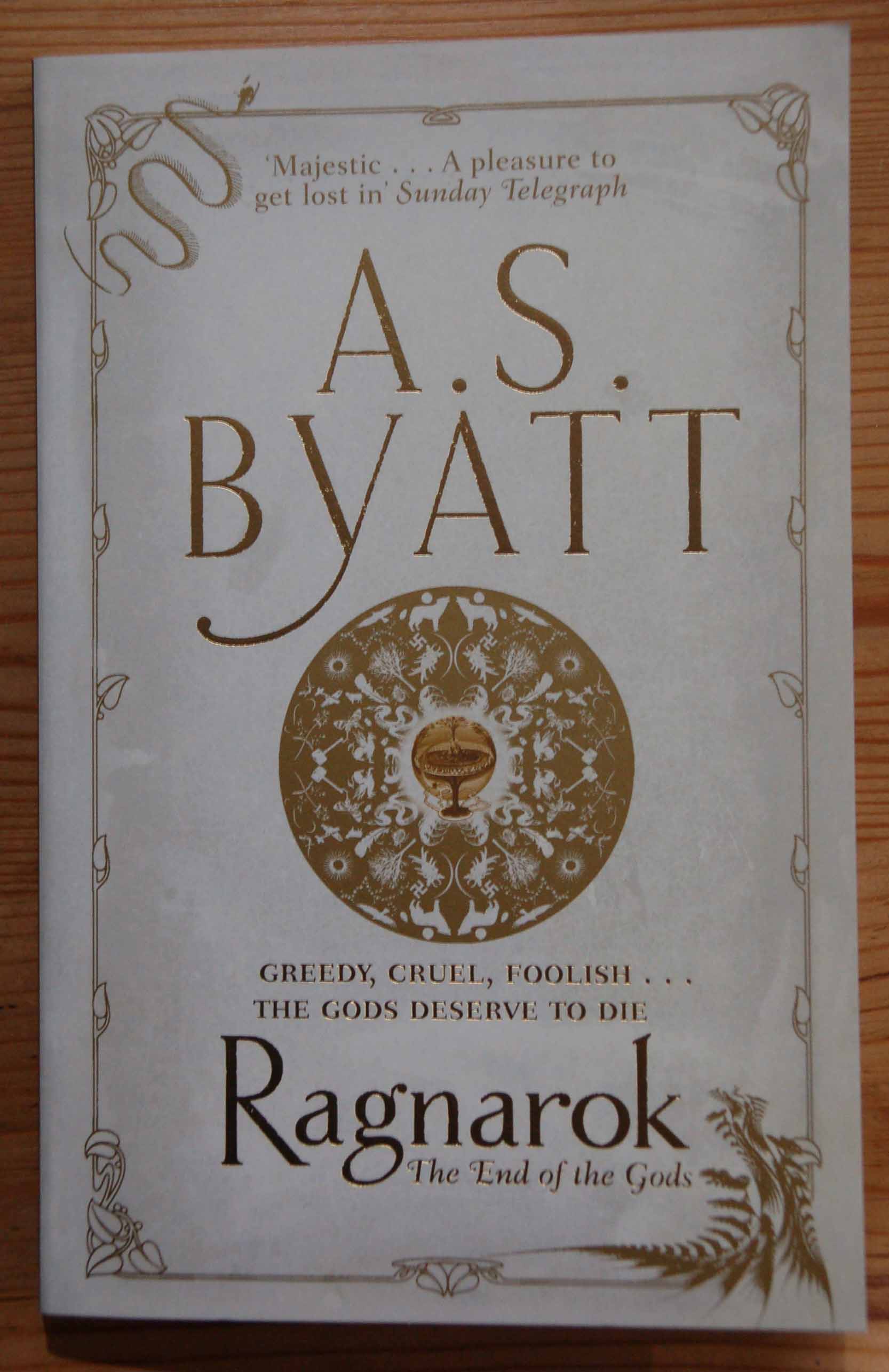
Reading is easier than writing. No need for research, no searching for ideas and inspiration, no getting into the mood, no agonising over the construction of sentences and the order of events and whether characters, and the plot, are interesting, or even credible. No need to struggle for half an hour before finally admitting that you’re just too tired. Just sit down and do it. Easy. If I sound surprised, it’s because I’d forgotten. I’m embarrassed to admit it, but I hadn’t read a book for many months – I’ve been too busy writing. Over the last week or so I’ve managed to fit one in; just a small one, called ‘Ragnarok, The End of the Gods’ by A. S. Byatt.
Ragnarok
I like Byatt’s books; the way she writes. I like her writing style, and she always finds something interesting to write about too. Ragnarok is one of her stranger offerings. It’s based around the mythology of the Norse gods. It has a lack of cohesive narrative, which I found a little bit frustrating, but this is mostly because the mythology she describes doesn’t have much of a sensible narrative – it’s rather rambling and incoherent. I think she has tried to relate the stories faithfully, rather than trying to re-write or re-interpret them, or putting them into a modern context (she discusses her approach in the last chapter; ‘Thoughts on myths’). The mythology is interspersed with passages following a fictional character – a young child who has been evacuated from London to the countryside during the second world war. This character is never fully developed; the author deals only with her (the character’s) feelings about the natural environment and about the book ‘Asgard and the Gods’, in which she has immersed herself. Byatt mentions a number of times how she herself read this book as a child and was very influenced by it, which leads me to think that the character (who is never named, only referred to as ‘The Thin Child’) might be autobiographical. Perhaps this is unfair of me. I don’t know whether Byatt herself was an evacuee, but she would have been the right age, so it’s quite possible. I was interested to see that the book was commissioned (‘when Cannongate invited me to write a myth…‘).

In place of a proper narrative we get a good deal of philosophy and analogy, and some very poetic writing. The book is full of names; strange, Scandinavian sounding names, like Hraesvelgr, Vedrfolnir and Nidhoggr. At times it reads like an IKEA catalogue. In an approach that Dawkins would be proud of, Byatt compares the Asgard myths to modern religion, and in particular to Christianity, and rather boldly makes the point that whilst they both deal with the same subject matter, and neither is credible, the Norse stories are at least interesting and engaging. I wonder if she receives hate mail..?

There is another analogy too. In the stories, the gods are too dense, too greedy, selfish and incompetent to do anything to avert their impending downfall. A parallel is drawn to the behaviour of modern day humanity. It’s clear that our behaviour is driving us (and indeed the planet we inhabit) toward destruction. We’ve known this for decades, and yet we seem incapable of taking action to change our behaviour and avoid disaster. Are we (or at least, are our leaders) just as short-sighted, greedy and stupid as the Norse gods?

Of course, there are many similarities between reading and writing. Both can be incredibly engrossing. Both can keep you up late at night when you should really be trying to get some sleep before the alarm wakes you early the next morning. Writers create worlds in their imagination; readers re-create those worlds using the instructions encrypted in the text. While writing is my priority, I do love reading too. So many books, so little time…

Posted in reviews, Writing | Tagged , , | Leave a comment

Can Atheists endure Christmas?

So, it’s over, the thing known as Xmas; that temporary distraction from the cold, wet, bleak British winter. This year I’m feeling somewhat more relieved about that than usual. Maybe I’m getting paranoid in my old age, but this Christmas I felt a little uncomfortable. It began when I heard Radio 3’s breakfast show host posing the question ‘can atheists celebrate Christmas?’ and asking the listeners to send in their assorted reckonings, many of which turned out not to be exactly ‘inclusive’. I shouldn’t have been surprised – the BBC isn’t exactly renowned for being secular-friendly. I’ve never really had a problem celebrating Christmas in the past, so I was put out to hear that actually, it’s not for me. I switched to Classic FM (the option of last resort) where I heard a comment by one of their presenters; a throwaway comment to the effect of ‘isn’t it marvellous that we’re a Christian country?’ (I don’t remember the exact words). I was quite shocked, but mostly rather sad, to think that a presenter could so casually alienate 50% of their audience with one thoughtless, ignorant and rather inaccurate comment. After that, it turned into an onslaught. Whether on radio or TV, I heard bishops and archbishops making facile comments that assumed we all share their beliefs. I heard carol concerts everywhere, and every other piece on Classic FM was a Christmas carol. I’m against the monarchy (now don’t tell me you’re surprised!) so I try not to watch the queen’s speech. This year I inadvertently came in on the middle of it and heard the poor old dear wittering on about god. Doesn’t she know that half of her ‘subjects’ (this is why I’m anti-monarchy – like Patrick McGoohan in ‘The Prisoner’, I consider myself to be a free man; no-one’s subject) don’t believe in god, and don’t consider themselves to ‘belong’ to the church of which she is the head?

Don’t get me wrong, I understand that many people want to celebrate Xmas as a religious event (notwithstanding it was originally a pagan festival that was annexed by the early Christian church). I’m happy for them; happy to let them fill their proverbial boots without criticism or interference, happy to respect their beliefs. I don’t mind a few carols. I might even have been tempted to go along to midnight mass for a good old sing-along (although the inevitable sarcastic comments about how full the church is now it’s Christmas can get a little tedious). But it seems to me that the religious establishment, supported by the media, and particularly the BBC (or Bible Broadcasting Company, as it’s known) is becoming increasingly insensitive to those who have a different world view to them; increasingly intent on restricting our rights to freedom of expression and belief – freedom of thought even. Their tone is increasingly bullying.

Religion plays no part in most peoples Xmas. It’s seen as a time for relaxing with family and friends, for giving and receiving gifts; a time to withdraw from the stress of day-to-day life for a well deserved rest. Which seems to me to be perfectly reasonable. We should be free to celebrate Xmas in these ways, just as the religious are free to celebrate it in accordance with their beliefs. All I want is a little tolerance.

Still, it’s over. Just Easter to look forward to now..! I hope that you all had the Xmas you wanted (if indeed you celebrate Xmas at all) whatever your beliefs, and wish you all the very best for the year ahead.

Posted in Religion | Tagged , | Leave a comment

Christmas comes early for British politicians

We are living in a time of austerity. A time when the cost of paying off the deficit, which came about largely because of the greed and stupidity of the banks, is being borne by the poor. A time when the number of people living in poverty has grown to an unprecedented level and ever more people are trapped in low paid jobs or are unable to find a job. A time when wages are falling and the differential between rich and poor has recently been measured as the biggest since Victorian times. But now it’s a special time of year. Christmas? No, it’s the time of year when the MP’s get their pay rise. So yes, actually – it is Christmas, so far as they are concerned. Because they are to be awarded an 11% pay rise. Interesting, when you consider that the government is cutting the wages of most other public servants, many of who are amongst the lowest paid workers in the country.

Of course, the rise has been recommended by an independent (supposedly) committee, so it’s not actually the MP’s themselves who are saying they need a huge pay rise, you understand. You might think they would come out against this, tell us that it isn’t right in this time of austerity, when most other people’s incomes are falling. But no, they’ve been lining up to tell us just how much they deserve it. Apparently their wages are lower than people in equivalent jobs elsewhere in society, so they need a big pay rise. Jack Straw says that MP’s wages are not high enough to allow people who are currently on modest salaries to move into politics. Which begs the question; just what does he think constitutes a modest salary? I can tell him that there are very few people who would be put off by the current salary of around £66,000 a year, plus expenses and free accommodation in London. Apparently many MP’s struggle to survive on this, and need to have lots of other jobs (which usually involve little more than having their name at the top of companies’ headed note paper) in order to make ends meet. I’d like to see how they manage on a salary of £15,000 or less.

The truth is that MP’s pay is very low. At least, it’s low compared to what the public school educated elite that monopolise politics in the UK are used to. What we really need is for politics to be opened up to people from the other end of society – people who would be more than happy to do the job for the current salary. People who know the value of money, and what it is to try and survive on low pay. People who know what low pay is. And what it is, is not £66,000!

Posted in Politics | Tagged , | Leave a comment

First World or Third?

I was in San Francisco a few weeks ago and was shocked to see the level of homelessness and begging on the streets. In parts of the city there were three or four beggars on every corner. Looking out of the window of a bus as it passed through the Tenderloin area I saw pavements crowded with what appeared to be down-and-outs sitting or standing around aimlessly – dirty, down-trodden people surrounded by the sad paraphernalia of the homeless- filthy blankets and sleeping bags; carrier bags stuffed with goodness know what. Across the city I saw people foraging through rubbish bins. There was a bronze statue, a memorial to the great depression, and it seemed very poignant – apparently history repeating itself, despite the fact that we live in a time of plenty, at least for many people. And of course at the same time, and often in the same places, there were signs of great wealth, of conspicuous consumption – wealthy people flaunting designer brands, expensive jewellery and high-tech accessories. Exclusive shops and restaurants were busy, and there were plenty of very expensive cars cruising the streets.

In the UK, the divide between rich and poor has been growing steadily since Margaret Thatcher acceded to power in 1979 (and even more shamefully, didn’t stop growing during the years that the so-called Labour Party were in power) and is now reported to be the biggest since Victorian times. Food banks are springing up all across the country as more people are unable to feed themselves and their families. The numbers of the homeless are rising as house prices, and subsequently rents, continue to rise, pricing ever more people out of the ‘market’ of having somewhere to live.

In countries such as China and India there is a burgeoning class of people with more money than they know what to do with, whilst those at the other end of society are arguably no better off than they have ever been.

Perhaps this is the most significant effect of globalisation – the convergence of societies in the first and third worlds, the product of which will be a global, homogenised society of stark contrasts – of ‘haves’ and ‘have-not’s’, of filthy rich and dirt poor.

Posted in Politics | Tagged | Leave a comment

TB in Badgers provokes new cull

The government have announced a new cull to stop the spread of bovine TB. The cull is highly controversial and has been the subject of bitter dispute between its proponents and those who think it is cruel and will not be effective. However, a government spokesperson said extensive scientific research has shown that a cull is the only way to stop the spread of Bovine TB to Badgers. Sir David Varney, president of the Wildlife Protection Trust, welcomed the cull; ‘At long last this government has acknowledged the importance of our indigenous wildlife, and is taking action to protect these beautiful, natural creatures from the effects of intensive farming practices on their habitat.’ But a spokesperson for the National Union of Farmers warned that many of its members would refuse to co-operate. He called on the government to guarantee compensation for its members, many of whose livelihoods will be threatened.
The government intends to begin culling cattle on 1st November. The target figure of 100,000 animals is expected to be reached within four months, and it is likely to be another twelve months before the beneficial effects in the badger population begin to be seen.

Report reproduced with the kind permission of The Fictional Morning Herald (a parallel universe publication)

Posted in Environment | Tagged | Leave a comment